Showing posts with label drug war. Show all posts

Sunday, March 1, 2015

Mines, Water, Roads, Borders

The Resolution Copper land grab is also a water grab, with a projected use of millions of gallons per year and contamination of more; and during what could be a mega-drought. Water is often compared to gold as its value increases the more scarce it becomes, which means we may soon be fighting not only the increasing privatization of land, but also of water. Despite the fact that the Resolution Copper deal, having been snuck into a defense bill, involves an exchange of land, it is being done to the advantage of a transnational mining corporation and to the detriment of the Chi’Chil’Ba’Goteel/Oak Flat/Apache Leap area and the people who hold it sacred. This land grab represents a continued prioritization of economic development in so-called Arizona, which means more resource-extraction and increased international trade (specifically with or through Mexico). Mining and other industries shaped by trade-related demand bring not only risk to water, but also more roads like Interstate 11 and rail (which require land acquisition), and increased border militarization. US trade policy is largely culpable for the violence on the border and south of the border.

Economic development is portrayed as bringing more jobs, but these “free-market” policies, as in the case of NAFTA, are meant to redistribute wealth to the hands of the rich. Because of their trade relationship and connecting infrastructure, Arizona and Sonora have a shared fate as land, water, safety, indigenous ways of life and sacred sites are all at risk. The state governments enable resource-extraction and other infrastructural projects, lucrative to those who would build them and those who would finance them, through subsidization and protection with our tax dollars.


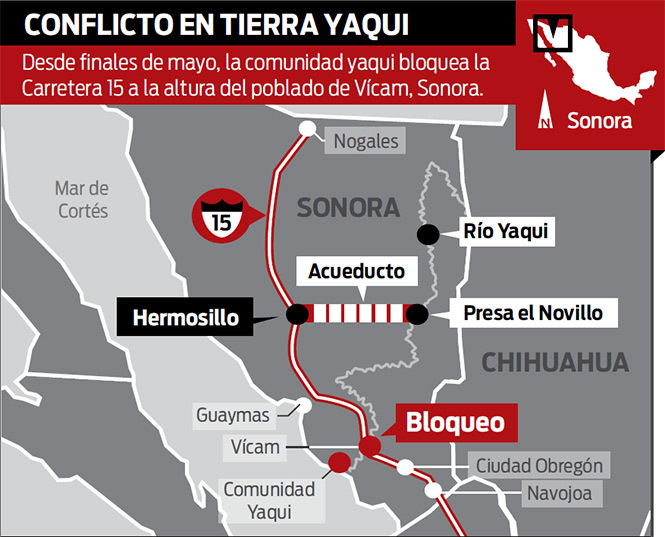
Arizona's connection to a port in Guaymas, Sonora is crucial to the Arizona mining industry. Copper is one of the fastest growing US exports, and much of what is and would be mined in Arizona would be transported down to where mining companies such as BHP Billiton (of Resolution Copper) and Freeport McMoran do business at this Mexican port on the Sea of Cortez. Guaymas is also significant because shipping companies can have lower standards for working conditions in Mexico versus the US. This port is the southernmost point of the CANAMEX Corridor, the NAFTA trade route connecting Canada and Mexico through five US states including Arizona. The Port of Guaymas has been expanding over the years and brings along its own set of problems in the vicinity, requiring its own energy sources and water, damaging the environment, impacting the local communities, etc. Arizona is counting on the continued growth of the Mexican economy, yet the importance of the Port of Guaymas also signifies that a lot of exports from the US are meant to cross the Pacific ocean (especially if the Trans Pacific Partnership goes into effect), not stay within its favored trade partner's borders.

The CANAMEX Corridor already exists, but will be considered complete once Interstate 11, which is in the study phase (aside from the Boulder City Bypass which is scheduled to break ground this year) has been constructed, connecting Las Vegas and Phoenix with a route fit for freight traffic. Interstate 11 may eventually refer to the entire trade corridor reaching from Mexico to Canada, or at least is intended to span from the Mexican border and beyond Las Vegas. Parts of it maybe multi-modal including rail and other infrastructure possibly including water pipeline. This massive project will cut through communities and damage the environment. Conceptualized as the entire trade corridor, it is currently also referred to as the Intermountain West Corridor--basically CANAMEX but with a more updated, more western route where it would run north of Las Vegas. South of the border, the Mexican government has recently agreed to the request by Arizona officials to improve Route 15, which is part of this Corridor, for freight traffic.


Intermittent blockades of Route 15 have been one tactic used by Yaqui resisters in response to the theft of their water in the last few years. The rapid growth of the City of Hermosillo in the state of Sonora, Mexico situated along the CANAMEX Corridor, on the way to the Port of Guaymas, is due in part to NAFTA-fueled agribusiness and mining which are the primary water-users. As it is, Sonora essentially exports millions of gallons of fresh water to the US in the form of fruits and vegetables. In the context of the drought and overuse of water, and as a result of the ways international trade has impacted Sonora, Hermosillo has required acquisition of water, impacting the Yaquis, Mayos, and Guajiríos with aqueducts and dams on the rivers. These mega-projects, enacted by Sonora SI (started by the Sonoran Governor who has a close relationship with the mining industry), have the intention of addressing the water crisis (for Hermosillo), contributing to the competitiveness of the region and providing new infrastructural projects for companies to make money from.

Since technology is now allowing for relatively affordable removal of salt from the plentiful ocean water, one megaproject planned for Sonora is one or more desalination plants. It is possible that the Agreement of Cooperation between the states of Arizona and Sonora signed by the respective governors at the Arizona-Mexico Commission’s Plenary Session last summer to jointly evaluate the feasibility of desalination at the Sea of Cortez for a new water supply for Arizona and Sonora is related to the Sonora SI project, which includes a desal plant in San Carlos near Guaymas. The potential for desalinated water piped from California or Mexico is part of Arizona's official water strategy. This year, a bill is in the Arizona House of Representatives to fund and arrange a study for the potential for desalination for Arizona. The intention for Arizona to expand and become more competitive in trade, along with potential new copper mine(s) will mean new demand for water, and with the combination of scarcity and new infrastructure, the water could be privatized. Desalination plants threaten the environment in various ways including the direct impact on their location on the water, as well as through the use of energy in the process and transport of the water.

Despite the likely need for drastic measures even if Arizona doesn't grow, some in Arizona find that expansion is necessary and inevitable. A so-called “megapolitan” area including Phoenix and Tucson called the “Sun Corridor” is intended as an economically integrated trade hub along the CANAMEX Corridor. Those interested in this concept have been attempting to reform state trust land law in the interest of further growth and development. The Sun Corridor concept is supposedly justified by—at the same time as it is used to encourage—growth and accompanying infrastructure especially for freight traffic in the area despite that growth is not sustainable in the area. The infrastructure required includes new roads, rail, ports, and border security.

Along with the steps to build Interstate 11, just in the last few months, Arizona opened trade offices in Hermosillo and Mexico City, committed funding to increase freight rail infrastructure near the border and to expand ports of entry at the AZ/Mexico border. According to ADOT's press release, Arizona was involved in a US/Mexico joint investment “implementing U.S. technology, equipment and training to enhance the efficiency of the military inspection station north of Hermosillo," which involves $6.8 million almost certainly from the Mérida Initiative, with an additional $4 million from the Mexican Government.

The primary intention of the Mérida Initiative (also known as Plan Mexico, a reference to the failed Plan Columbia) is supposedly to fight the drug trade, but one major role, to create a “21st Century Border Structure,” deals with trade and migration as well. This is meant to “Facilitate legitimate commerce and movement of people while curtailing the illicit flow of drugs, people, arms, and cash. The Mérida Initiative will provide the foundation for better infrastructure and technology to strengthen and modernize border security at northern and southern land crossings, ports, and airports.” Sure, the US wants to prevent the illicit activity that correlates with increased movement of trucks across the border. It is also the trade policies themselves, and the accompanying poverty and displacement, that contribute to migration (and arguably contribute to the drug trade). Many in US benefit from exploiting the cheap labor created by criminalization of migrants. And then there are the security and technology companies who can profit from infrastructure and equipment involved in securing the border. Large transnational companies such as Israeli company Elbit Systems brings their similar experience in militarizing the Gaza Strip and enforcing their apartheid wall to the border as well. The potential for any future Comprehensive Immigration Reform to bring about a "border surge" manifesting a massive profit-making opportunity for the military industrial complex to the US/Mexico border will likely make it even worse than it already is. Migrants continue to die crossing the border. Tohono O'odham who live along the border or visit relatives also face daily harassment, abuse, check-points, invasion of privacy, limits on movement, drones, cameras, etc. due to the border patrol's activities where the border bisects their lands.

Arizona officials and business leaders want to believe the myth that Mexico has the violence and organized crime under control. In the interest of becoming more friendly to international investment, for just a few years prior to the violent disappearance of the students from Ayotzinapa in late 2014, Mexico attempted to make itself look as though it was successfully instituting the rule of law. Yet law enforcement is clearly involved in much of this violence. And U.S. trade policy is largely culpable. Many violent acts tend to be depoliticized and obscured by associating the victims with drugs. Students at the Normal school in Ayotzinapa were known for protesting neoliberal reforms in Mexico. The fact that they were clearly not involved with the drug trade and that it involved so many youths made what happened to them more worthy of media attention.

The drug war, instead of curtailing the production and movement of drugs, functions, even if not specifically intended to, to facilitate resource-extraction and international investment in areas such as Mexico and Central America. Militarization and paramilitarization benefit US and transnational corporations' involvement there through displacement and social control, as described in Dawn Paley's new book, "Drug War Capitalism." With at least a couple dozen mining conflicts in Mexico alone, and the violence faced by activists who oppose mining, it is clear that even when organized crime groups are involved in law enforcement and violence, these are often acts of repression. For mining to continue, people are forcibly displaced, and the state facilitates this, in part by US tax dollars and to a certain extent for Arizona trade interests. Mining companies around the world often have arrangements with paramilitaries and/or military to protect them, such as in the cases of Resolution Copper's BHP Billiton in Columbia, and Phoenix-based Freeport McMoran in Indonesia.

In modern history in Arizona, displacement looks different but is no less significant. Confiscation of livestock, used as a tactic of attrition to force Diné who have resisted displacement from their lands so Peabody Coal can continue strip-mining the Black Mesa area, has occurred as recently as October 2014. Some members of Congress have recently urged that the relocation project be completed. Arizona's urban areas' access to water and electricity involves a mega-project that has a complex history few know about, which is all the more relevant in relation to the Yaqui water struggle and the potentiality of infrastructure being built for desalinated water. Often characterized as savvy and industrious, the efforts made to create the Central Arizona Project (CAP) that brings water from the Colorado River, and the whole project including Peabody Coal's strip-mining (to fuel the generating plant that powers CAP and provides electricity to Phoenix, Las Vegas and other areas), rests on a history involving manipulation, manufactured conflict between the Diné and Hopi and among tribal members, forced removal of families, contamination and depletion of water, and the poisoning of those who have lived close to the mines and the generating station.

Indigenous people's access to clean and plentiful water has been threatened since settlers arrived, even after they were given priority water rights by the federal government. Not only did Southern Arizona settlers divert water away from sources Tohono O'odham and other indigenous people relied upon, and contributed to erosion of their lands, indigenous people have been swindled for their priority water rights over the the last several decades. The Arizona Department of Water Resources considers the resolution of tribal water rights claims (9 more out of 22 total) the number one priority due to the uncertainty of long-term water availability for Arizona. Often the settlements promise infrastructure to provide water delivered to homes on the reservations, instead of addressing the root causes of poverty and lack of access to clean water. The mining industry consumes and contaminates water on a massive scale, and because of how much water it depends on, is especially interested in securing water rights at the expense of priority water rights held by some tribes in Arizona, such as in the case of Freeport McMoran being involved in the settlement of Hualapai water rights claims last year.

In some cases, mining companies like Freeport McMoran have been buying land for the associated water rights. Freeport and Resolution Copper have benefited from legislation and/or legal exemptions that allow them to essentially hoard water. No doubt the Resolution Copper mine near Superior would use several millions of gallons of water a year. Rio Tinto (of Resolution Copper) has purchased future water rights from CAP. The risk to water in AZ will be compounded if the Rosemont Copper mine near Tucson also gets approved. Access to clean water that is also affordable becomes a grave concern as water becomes scarce, commodified, and potentially privatized as more infrastructure is involved in its acquisition and treatment.

As is implied in "There is No Drought: California's Twisted Waterways," the threat of a serious drought can be used by those interested in profiting off the scarcity of water, and the "solutions" which are proposed are those that benefit these private interests. Obama made water privatization in the US easier, when on June 13 of 2014, he signed the Water Resources Reform and Development Act (WRRDA) into law. This included the Water Infrastructure Finance and Innovation Authority (WIFIA) which is a 5-year pilot program providing financing for P3s for water projects. WIFIA, mirroring the "Transportation Infrastructure Finance and Innovation Act" (TIFIA), was a concept developed and promoted by the American Water Works Association (AWWA). The new director of the Arizona Department of Water Resources was a member of the AWWA.

Additionally, various companies involved in other Arizona infrastructural projects (AECOM, CH2MHill, CDM Smith, Bechtel) are involved in water privatization across the world.AWWA, a non-profit, is supported by CH2MHILL and closely affiliated with AECOM. And with more P3s for transportation, the likelihood for P3s for water increases.

Private interests have pushed for Interstate 11 due to its role in trade. I-11 is also likely to be procured as a public-private partnership (or several). Public-private partnerships (P3), a type of arrangement which we'll be seeing more of in the coming years (and is in the works for the South Mountain Freeway), are proposed as a mutually-beneficial solution that uses complicated financial strategies to leverage state assets and essentially provide federal and/or state subsidies (through tax-free bonds, low-interest loans, etc.) to the private sector. It helps finance projects for which funding is otherwise lacking—therefore it is a much desired arrangement for construction and engineering companies, consultants, as well as banks. The P3 creates new profit opportunities for financial institutions, in the meantime creating more debt, and therefore it is largely about financialization. A P3 can also be understood as a form of privatization, not because a P3-built road would not be publicly accessible, but because P3s afford private entities influence, agency, and financial deals they would otherwise not have access to. Projects such as roads are more likely prioritized based on the interest of private parties, and based on what is incentivized by the federal government. A public-private partnership could also refer to an organization ("P3 unit") that involves public officials and private members, creating new forms of governance that provide opportunities for private involvement in decision-making.

Two such P3 units of note in Arizona are the Arizona-Mexico Commission (AMC) and the Transportation and Trade Corridor Alliance (TTCA). Both of these organizations involve the Director of the Arizona Department of Transportation and other state officials as well as various corporate leaders, with much overlap between the two. The pro-NAFTA AMC, who takes credit for pushing CANAMEX along, seems to have had a lot to do with getting TTCA instituted and becoming a major influence in Arizona policy on trade and transportation in recent years. Freeport McMoran has been a major sponsor of AMC and has had someone on the board of directors for several years. The locations of Freeport's Arizona mines and their use of the Port of Guaymas correlates with their interest in CANAMEX and I-11. Freeport hired the last director of the Arizona Department of Water Resources as their water strategist, and this department now has an intimate relationship with AMC, even listing AMC

It is no surprise as well that Senator John McCain has been a large proponent of the land swap for Resolution Copper, the Mérida Initiative, increased trade with Mexico, and the TPP. But this goes far beyond him and the AMC. Across the world, the World Bank and IMF have coerced countries into adopting structural adjustment programs or other changes in exchange for access to loans. We may be aware of austerity measures in the US, but we may not realize the various ways in which Arizona (or other US states for that matter) is also impacted by state-enabled free market ideology even as the state is not forced into formal agreements to open new areas up to private "partners." The economic development, made to seem intended to create jobs and improve the livelihoods of citizens is about nothing more than accumulation of wealth. It is clear though, that whether we call it neoliberalism, capitalism, or colonialism, is also a project of the state.

Wednesday, June 8, 2011

"The New Jim Crow" speech relates to immigration

I'm very interested in the parallels between the criminalization of black people and the criminalization of migrants, and the parallels between the drug war in general and the criminalization of migrants, as I've written about at No Borders or Prison Walls. I recommend checking out this speech by the author of "The New Jim Crow".  She doesn't talk about immigration, but you can see how what she talks about relates to it.

I'm also interested in looking at the roles the private prison corporations might have played in any legislation relating to the drug war, as they have with the criminalization of migrants with SB1070 both through ALEC/Russell Pearce and through Governer Jan Brewer.  I intend to look further into that.  I'm also interested, though, in why it the privatization of prisons isn't the problem per se.  There have been economic and political reasons for people to be imprisoned before prisons were privatized.  I discuss that a bit in What came first: the Racism or the Profit Motive?  You can expect more on this in the future.

Wednesday, May 25, 2011

Drug War/Anti-Immigrant Hypocrisy

Don't you love when officials get slapped in the face with their own hypocrisy?  I have posted numerous times about border patrol agents and national guard down near the border getting caught trafficking drugs while the general attitude promotes the stereotypical Mexican drug trafficker.  Just recently, the biggest villains in Maricopa County have both had their hypocrisy exposed.

Just recently 3 of Sheriff Arpaio's deputies were arrested for their involvement in drug trafficking.  One is suspected of having been corrupt for ten years.  Arpaio knows that drugs are trafficked by cops and other government officials, but turns a blind eye.  Meanwhile, he acts as though Mexican immigrants are the criminals (some are, but obviously some police are too).  To top it off, he often portrays his officers as saviors of people held captive by human traffickers even as those officers also keep the same folks captive in their custody (and/or transfer them to detention or have them deported).

Senator Russell Pearce's son has gotten into trouble a lot, but the most recent news is that he violated his probation by smoking pot and will serve a year in prison.  This is likely a light sentence for such a thing.  Of course the Pearces, or mormons, or white people are not tinged with the stereotype of drug addicts, nor as law breakers.  Mexicans are said to be the problem.

As I have pointed out before, the media tends to be a lot more understanding of the pressures involved in being an official down at the border and getting caught up in drug dealing.  The big drug traffickers have the money to offer relatively low-waged border patrol agents.  These agents are just parents who want to provide for their family.  They're vulnerable to corruption because things are hard economically.  Yeah, and isn't that the case for Mexicans too?  Somehow we can just picture Mexicans as particularly devious and having no qualms about getting involved in drug dealing, whereas white people/US citizens give some resistance but cave in out of desparation.  We should also consider that there is a wide range of involvement in the drug trafficking industry from the people heading the cartels, the folks who torture and murder others, to the small time pot dealer who could easily be your friendly neighbor who wouldn't hurt a flea.  The thing about being a cop or an agent or a national guardsman is that these folks have the legitimacy and the tools they need to give them access to that which wouldn't be possible for other folks.  They can cross the border unquestioned, they can use their authority and gun for criminal uses.  They've been empowered to be even better drug traffickers than those without the uniforms and badges.

We must also acknowledge the ways in which the drug trafficking scene is so much more violent due to the involvement of the government.  Recently there have been massive demonstrations by Mexican citizens demanding that the military remove itself from the war on drugs.  It's making things worse.  Of course the Mexican government is corrupt, and they're likely fighting certain cartels in favor of other cartels.  Weapons and training (such as torture and murder) are provided directly or indirectly (though of course quietly) from military to cartels.  People defect to the cartels because they pay better.

An overarching theme here is that drug trafficking pays better than most other jobs.  In situations where people are hurting for money (such as poverty especially south of the border but also in the US) on top of the social pressures of showing you can purchase expensive things (particularly here in the US) and people getting into huge amounts of debt, how can anyone expect that people will steer clear of drug trafficking?  If the state did not prevent people from (re)obtaining the means of subsistence (such as land), then they would have alternatives to these activities.  If drugs were not illegal, there wouldn't be so much money in it, and there wouldn't be so much violence involved.  If people were not so alienated and beaten down in their daily lives, there would be less demand for drugs in the first place.

See also: National Guardsmen Caught in Drug Smuggling Bust
Ex-ICE Officer Charged in Drug-Smuggling
Authorities bust major marijuana smuggling ring
Ex-ICE Officer Charged in Drug-Smuggling

Tuesday, January 18, 2011

National Guardsmen Caught in Drug Smuggling Bust

So they say the border isn't safe and that's why we need the national guard there, but then when national guardsmen are involved in a huge drug-smuggling ring, the former AZ attorney general says, "The involvement of uniformed military personnel and children show the extent to which the cartels will go to pursue their illegal schemes."  It doesn't show the extent that national guard statesmen can go because they're not looked at with suspicion?

The involvement in the drug trade by military, police, border patrol, prison guards, not to mention the CIA and such, has been extensive.  It is ridiculous that migrants are the ones stereotyped as drug smugglers (yes there are drug smugglers from south of the border just like there are white drug dealers in middle class neighborhoods) and when people with some sort of authority get involved in the drug trade it supposedly speaks more to "the extent to which cartels will go".  Similarly, I point out in Ex-ICE Officer Charged in Drug-Smuggling, there is much more sympathy towards officials than towards Mexicans.  As though Mexicans are naturally corrupt, while officers get corrupted by the former.

No it couldn't be American demand, plus greed, poverty, capitalism, and the fact that drug smuggling (and human smuggling) is illegal that causes people to get involved in the trade.  And it wouldn't be the impunity, authority, and trust afforded officials that allows them to participate in the drug trade more effectively because of their position that causes them to be involved.  One wonders what the drug trade would look like if nobody tied to the government ever participated in it.

It's especially unfortunate that the drug trade negatively affects the Tohono O'odham and then on top of that, they have people who are "protecting the border" also negatively affecting the community, in addition to some involvement in the drug trade.  People transverse the entry port in the Tohono O'odham Nation and surrounding areas because of tightened border controls in other more urban regions.  It will be interesting whether this will be an excuse to tighten border security on T.O... just before the Unity Run too...

Anyway, here's the article: Authorities bust major marijuana smuggling ring. 
And Ex-ICE Officer Charged in Drug-Smuggling is worth reading too, in my opinion, even though it's a little old.

Friday, January 14, 2011

Private Paramilitary-Style Training Camp Approved for Border

A company called Wind Zero got approval to build a huge private complex for paramilitary-style training, similar to the camp proposed by Blackwater (now Xe).

According to Narco News' $100 Million Drug-War Garrison Approved for U.S.-Mexican Border, the company's founder, former Navy SEAL sniper, U.S. intelligence agency operative and author Brandon Webb said in a YouTube video: 
Mexico is very close to civil war right now; it doesn’t take much to buy off somebody and next thing you know, the president is assassinated and then what? A civil war breaks out, and we have a million Mexican citizens crossing the border into the U.S., and it’s the same situation that you have in Afghanistan and Pakistan. You have all these refugees coming across and Pakistan’s like, “What do we do with this?”

It’s not outlandish for that scenario to happen. So how do you prepare for that? You got to train these guys, and that’s law enforcement and the military.
The article notes that there are likely to be plans to operate drones, aka unmanned aerial vehicles (UAV) out of this facility.
Currently, under the oversight of the Department of Homeland Security’s Customs and Border Protection agency, about a half a dozen Predator B (Reaper) drones are now operating along the southern U.S. border and coastal regions of the U.S., from Florida through Eastern California.
And it seems the Mexican government itself is operating UAVs, or drones, over the U.S.-Mexican border. A recent news story revealed that a Mexican drone dropped out of the sky earlier this month and crashed onto an El Paso, Texas, street...
The U.S. and Mexican governments are already operating joint military missions targeting so-called “kingpin” narco-traffickers. As evidence of that reality, the Washington Post recently reported on a State Department cable made public through WikiLeaks that supports facts reported by Narco News in June 2010...

Would it be any surprise if the U.S. and Mexican governments, via private contractors and/or government operations, also are coordinating drone missions along the border?
(It's worth noting as well that Miami Police have recently purchased a drone for the use of keeping tabs on the residents as well.)

About the training "camp" Narco News continues: 

Beyond its usefulness as a drone operations and training center, the planned Wind zero camp also will offer plenty of other features necessary for training special operations soldiers and/or paramilitary forces.
The camp, which would be developed in three phases at a cost of up to $100 million (some $15 million for Phase 1), also will include numerous shooting ranges allowing for some 57,000 rounds of ammunition to be fired off daily; a mock-up of an urban neighborhood for practices assaults; a 6-mile dual-use race track for teaching defensive and offensive driving (and for private-pay recreational use); and enough housing and RV camper space (along with a 100-room hotel) to accommodate a small battalion of warriors.
The article states that residents of the town, in addition to the Sierra Club have opposed this project, but, "Wind Zero marshaled the support of numerous law enforcement agencies in the region that would be able to make use of the facility for training purposes."

Tuesday, February 23, 2010

No More Deaths: Recent abuse interviews from Nogales

From a No More Deaths Newsletter:

No More Deaths volunteers working in Nogales continue to document and denounce abuses experienced in custody by deported migrants and immigrants. The following interviews were conducted in the last week. Please share these stories with your friends, family, congregation, and community.
  • Interview conducted 18 February 2010. Interviewee, man from Sonora, Mexico, requested to remain anonymous. Interviewee reported that while attempting to cross for a second time, after walking for three days in the desert, he and his friend were apprehended by three US Border Patrol agents in green uniforms. The agents apprehended them on 15 February 2010 at approximately 10-10:30am. The agents spoke Spanish. The agents accused the interviewee of carrying drugs and beat him in the head with the butt of a pistol. He collapsed to the ground and was bleeding heavily from the gash in the left side of his head. The agents called an ambulance (presumably a BORSTAR ambulance) which came and brought the interviewee to a hospital. He reported that he received staples in his head at the hospital but when he was released from the hospital he did not receive any papers or documents about the injury he sustained or the treatment he received. He reported that the hospital was small and the doctor who treated him did not have any identification. After being released from the hospital he and his friend were taken to custody in Tucson where they were given deportation papers, in English, to sign. They were given only crackers and juice to eat. They were deported 18 February 2010 to Nogales, Sonora. The friend, who witnessed the assault and was present during the interview, confirmed the interviewee's testimony. At the time of the interview the interviewee appeared to be in a state of shock.
     
  • Interview conducted 19 February 2010. Interviewee Bernabel R------ A------, from Guanajuato, Mexico. Mr. R------ is blind. He reported that he was taken into immigration custody in November 2009 in Texas, where he was held for three months before being taken to court in El Rio and deported to Nogales, Sonora. He had lived in Seattle, Washington, for three years and still has brothers there. In custody in Texas all of his papers (for a bank account at Bank of America, his passport, and other documents) were taken. When he asked for them to be returned he was told that they had already been thrown away. He was deported to Sonora, Mexico, in February 2010. He stated that he wanted to report the loss of the documents so that other people would not have to endure similar abuses.
     
  • Interview conducted 19 February 2010 collectively with three women who were held in custody in Tucson from 17 February 2010 to 18 February 2010. One of the women, from Chiapas, has three children in Chiapas, aged 8, 10, and 12. She stated that she was attempting to cross for the first time in order to find work to support her children. She was taken into custody in Tucson and brought to streamlining at the Tucson courthouse. She stated that guards pushed the detainees who were chained and could not walk quickly. She stated that one guard held her nose in front of the detainees and said they smelled. Another interviewee stated that when she was apprehended with a group in the desert a Border Patrol agent accused them of carrying drugs and threatened to shoot them. The third interviewee reported that guards shouted at them and used racist language. She gave the name of one agent in particular in Tucson, Mr. J. V------, who was especially abusive. All three women reported that they had their clothes taken from them and were held in extremely cold temperatures while in custody.

Sunday, September 6, 2009

Ex-ICE Officer Charged in Drug-Smuggling

Yet another case of law enforcement officials involved in drug smuggling was exposed this week. Richard Padilla Cramer was arrested for conspiracy to smuggle cocaine into the US. Cramer was a former high-ranking U.S. Immigration and Customs Enforcement agent who worked near the border in Arizona. He retired in 2007.

The Associated Press recently published an article about their investigation on corruption among law officers on the border. Unlike any discussion about Mexican citizens or migrants involvement in drug trafficking or other crimes (or US citizens of color involved in drug dealing), this article was very sensitive to the officers' vulnerability to bribery. Nonetheless, they exposed that this isn't just a case of rotten apples. I would take it one step further and argue that this is a systemic problem- that law enforcement is by its very nature corrupt.

It is ridiculous that the supposed attempt to fight the drug war is to get more law enforcement involved. It's no wonder that since the Merida Initiative, aka Plan Mexico, there has been more corruption (I discuss this further in Breaking Down the Mexican Drug War).

From On Border, Agents Struggle with Corruption
As Calderon sent thousands of soldiers to northern Mexico to stop the gruesome cartel violence and clean out corrupt police departments, CBP, the largest U.S. law enforcement agency, boosted its border forces by 44 percent or 6,907 additional officers and agents on the southwest border.

At the same time, CBP saw the number of its officers charged with corruption-related crimes nearly triple, from eight cases in fiscal 2007 to 21 the following year...

In the past 10 months, 20 agents from CBP alone have been charged with a corruption-related crime. At that pace, the organization will set a new record for in-house corruption; 90 employees have been charged with corrupt acts since October 2004. Agency officials expect those cases to continue to climb: There are 63 open criminal investigations - including corruption cases - against CBP employees.

I have been casually keeping track of cases such as this for a few years. I have been particularly interested in the fact that migrants are stereotyped as drug smugglers while law enforcement is not. While obviously nearly everyone has vulnerability to this lucrative business.

Human smuggling, is another lucrative business. Most of these non-drug related corruption charges involve providing "legal" paperwork for folks crossing the border- probably those who have money and are therefore probably involved in the drug trade. So who's to blame for drug traffickers entering the US.

An opinion piece from October 2006, Corrupt officials at home hinder real immigration reform lays out a number of examples of border-area law enforcement corruption, particularly drug trafficking, such as this example: "Border Patrol agent David Duque faces up to 15 years in prison after he pleaded guilty to accepting bribes in exchange for legal documents. He sold fake passports, birth certificates and Social Security cards. He even received $5,000 to allow a cocaine shipment through the Texas border."

Surely decriminalizing drugs and migration would solve the problem of corruption. And surely poverty and the perceived need for more and more money by those who already have it are to blame as well. People will always have incentive to do wrong within capitalism. The drugs and migration are not necessarily the problem in and of themselves- it's the abuse of the drugs, and especially the violence that pervades these underground markets, that are the problems.

While watching a video on the Mexican drug trade, I wrote down a quote from a woman who was heavily involved in drug trafficking in Mexico: "You'd have to wipe out the government to wipe out drug trafficking." I'm quite certain she was referring to how corrupt the Mexican government is. But clearly government officials, with their power, access, and impunity (mostly), along with everyone assuming they're innocent because they are part of law enforcement, are not immune from participating in that which they claim to counter, whether in the US or not. So maybe we really would have to get rid of the government to get rid of these crimes.

By the way, since Arpaio was involved with the DEA in Mexico, someone should really look into what he might be hiding...

Sunday, April 19, 2009

Important Items

This article makes me suspect that the federal investigation into 287(g) in maricopa county might just happen to result in an end to that program and an implementation of a new "improved" law enforcement strategy...
Fast-Tracking Secure Communities

"Secure Communities" is coming your way.


Immigration and Customs Enforcement (ICE) says that it plans to have the new “criminal alien” program working in most communities in the next four years.

Unlike the controversial 287(g) Program, which cross-designates local police as immigration agents, Secure Communities is fostering “inter-operability” between ICE and all federal, state, and local law enforcement agencies. The program works by making checks by law enforcement offices of criminal (FBI) and immigration (ICE) databases automatic. (more...)


Also check out this report on the changes in the approach to immigration, as well as how it's not likely to be any better...
Immigrant Crackdown Joins Failed Wars on Crime and Drugs

Sunday, March 29, 2009

Breaking down the Mexican Drug War

It is interesting to see how quickly the debate about border security has become dominated by the issue of violence and drugs. I thought i was just hearing more about it because i became interested in the parallels between the drug war and the war on migrants, turning to narco news for information, which also resulted in me getting google news alerts on the merida initiative or plan mexico. I have several articles bookmarked, waiting for me to read so i can better understand the implications of the plan mexico and other responses to the violence and the drug trade.

The drug cartel violence has been in the news in the US more lately because Hillary Clinton went down to Mexico to talk about it, and Obama recently decided to send more agents down to the border. I believe that some people are mainly afraid of the violence touching US citizens. I believe there are other stronger political motivations for getting involved.

What i have made of it so far is that the violence has increased because the drug war in Columbia caused cartels to form or grow in mexico to transport the same cocaine, along with marijuana and other drugs. The political corruption in Mexico is well known. In fact, most people figure that in the war on drugs, it's just that one cartel has been favored over the others, leading to more access to resources and impunity and therefore more war over turf. Of course the mexican government would rather control the cartels, and several within the government probably want there to be no cartels. However, since illicit drugs are the number one source of revenue in Mexico, it's no wonder that so many people, from poor youths to police officers, to the president, and from what i hear even people in the US DEA, are involved in it.

An important part of this is Los Zetas, "former Mexican soldiers from an elite US-trained Special Forces team who deserted to work in the more lucrative drug trade". They were trained as death squads, and in torture at the School of Americas. "While Los Zetas started out as the Gulf cartel’s private army, they appear to be diversifying their operations. The DEA reported this year that it believes Los Zetas are attempting to break free from the Gulf cartel to form their own cartel... Los Zetas have entered the immigration industry in southern Mexico with relative ease and little resistance from other more established Mexican cartels." This and more information can be found at "Wall of Violence" on Mexico's Southern Border by Kristin Bricker. See also: US created monsters: Zetas and Kaibiles death squads by Brenda Norrell.

Despite knowing that Los Zetas were trained by the US and now are involved in the violence of the drug war that the US is so concerned about, the government wants to provide more resources and training to the mexican army. This also despite the common knowledge of the corruption. Of course, this isn't so unusual since we know that Osama bin Laden and others were also trained by the US.

The bad decisions made under the guise of a war against drugs also fits the pattern of the previous failed attempts in the war against drugs in Columbia. Efforts have not been made to deal with the demand for drugs (legalization, decriminalization and/or treatment). I believe that everyone mainly wants drug cartels under control. Whether or not they really want to stop the drug trade is another story. In fact, there is much evidence that the US government, or at least certain individuals are directly involved in the drug trade.

What I am primarily concerned about is what the training, resources, and whatever else is going to the mexican army will mean for indigenous and rebellious communities in mexico. There are already too many examples of disappearings, murder, torture, imprisonment, and other abuses as it is. Zapatista communities have been invaded by soldiers claiming to be looking for marijuana plants, despite the communities having a policy against drugs and alcohol. See another case: Video: Plan Mexico threatens peaceful Mexican communities. See also EZLN Criticizes the Drug War.

I think it was John Ross's book Zapatistas: Making Another World Possible: Chronicles of Resistance 2000-2006 in which he described foreign investor's concern that the Mexican government get the Zapatistas under control after the uprising in 1994. US investors have a lot of stake in being able to exploit mexican people and resources. Something that could not continue if they were able to break free. It is likely not a coincidence that the huge uprising in Oaxaca occurred recently and now the US government is getting involved militarily to help maintain the stability of the the country. On a side note, i find it interesting that so many anti-immigrant folks would argue that migrants should go back to mexico to fight for a better country. I hope that if it came down to it, those people would protest any effort the US government makes to help the mexican government stop a rebellion. I don't see that happening.

The Merida Initiative will also benefit the military industrial complex by putting money into buying US-made aircraft and other technology, as Kristin Bricker describes in US Releases $90 million in Plan Mexico Military Hardware and Training.

This drug war is, in a way, already affecting people in the US. Sheriff Arpaio is giving as his primary reason for pulling over every brown-skinned driver, the fact that some undocumented immigrants are falling victim to those involved in drug and human trafficking in maricopa county. This is resulting in the undocumented immigrants who get caught up in the sweeps lingering in jail, detention centers, or being deported, in addition to getting abused, in some cases, by officers (although aside from broken arms, i'd call the whole operation abuse).

In addition, youth of color in the US may be further targeted in the drug war. According to Kristin BrickerGangs: New Target in the War on Drugs? "Since the US is the world's biggest drug market and Mexican drug trafficking organizations' primary source of weapons, US officials can't blame Latin America for all of its drug woes. So they're turning to gangs. The US government recently released three major drug-related reports: the National Drug Threat Assessment, the International Narcotics Control Strategy Report, and the National Gang Threat Assessment. In all reports, gangs figure prominently in drug trafficking. The International Narcotics Control Strategy Report is broken down by country, and gangs feature prominently in almost every country report."

So the question is, what can be done? Although i never thought of myself as someone who would put effort into the legalization of drugs, this seems like a reasonable way to stop the drug cartels. In fact, i'm seeing more discussions about drug legalization in mainstream media and apparently El Paso's city council are talking about it as well. We know that the economic situation, as well as the natural corruptness of those in power are the main problem. People in the US need to bring to light was is really going on here, stop the Merida Initiative, and all militarization on the border, and in our communities. We need long term strategies fighting neo-liberal projects, capitalism, and the state in Mexico and the US.


Further reading:

US Police Train Mexican Police to Torture

Estado Fallido en México: Una justificación para la militarización (babel fish translation)

Why Plan Mexico will Crash and Burn

Video: Plan Mexico threatens peaceful Mexican communities

Thursday, March 19, 2009

Kidnapping and Violence against Undocumented Immigrants

Phoenix is the kidnapping capital of the U.S.. Why are those of us in the area barely hearing about it? Because it's happening to undocumented immigrants and drug dealers, not to those considered "us" by the media and the authorities. Can you imagine what things would be like if mexicans were kidnapping white people here in phoenix? It would be quite a different attitude coming from the media and government officials. Of course they're worried that the drug-related violence, which is much worse in Mexico, will touch "us" soon enough, which is partly why they are throwing money into the drug war in Mexico. Notice the statement below about not one involving a "truly innocent victim" in the article called Human smuggling makes Phoenix kidnapping capital of U.S.
In the past year, there were 359 kidnappings in Phoenix, and not one was legitimate involving a truly innocent victim, said Mark Spencer, head of the union which represents more than 2,500 Phoenix police officers. He said all the kidnappings were connected to illegal immigration and the numbers may represent just the tip of the iceberg.

"The investigators up at the violent crimes bureau are estimating that this 359 represents just one-third of the reported kidnappings that take place in Phoenix," Spencer said.

Also view Napolitano's recent statements on putting more agents on the border.
"Every American has a stake in this," Janet Napolitano said in a phone interview with USA Today. "Violence on the border easily seeps into our communities. It also creates a fear in border communities that the rule of law doesn't apply anymore, and that's just unacceptable." (Source).

The kidnapping and associated violence are part and parcel of the underground economies which have resulted from the criminalization of drugs and unauthorized movement into the U.S.. Yet the police, such as sheriff Arpaio, use the kidnapping and violence as pretext to further terrorize undocumented immigrants. The police and homeland security are doing almost exactly what the kidnappers are doing: holding people against their will and profiting from it.

What do i mean they're profiting from it? Well, i intend to go into more detail in the future, but we can say for sure that someone is directly profiting from detaining immigrants. How about the "GEO Group, the nation's second largest prison company, [who] saw its earnings jump 29% over 2007," and other companies as detailed in How the Jailing of Migrants Drives Prison Profits.

The government is very afraid of the power and violence of the mexican drug cartels, though both profit from the criminalization of people and drugs. The Merida Initiative, also called "Plan Mexico" fits into the continuation of this profit-making, but adds a bit more control over the drug cartels.

"...according to human rights advocates, the plan prioritizes companies over people, lining the pockets of American defense contractors while putting both political dissidents and ordinary Mexican civilians at risk. Government documents leaked to the nonprofit Center for International Policy provide an idea of what the specifics of the plan will look like: more than half the funds would pay for technology and personnel to bolster the Mexican military's counternarcotics operations. The initiative would ignore the US's own involvement in the transport and sale of drugs" (Source).

I have only known of plan mexico for a couple months. Many people, despite criticizing the mexican government for corruption and human rights abuses, as well as criticizing the U.S. government for their unfair attitude towards immigrants, somehow have faith in this plan.

Rep. Ed Pastor, D-Ariz., who serves on the House Appropriations Committee, said he believes Congress will assess the program this spring.

"One of the things that we might be looking at is getting them more hardware such as helicopters," he said. "And there's a need for more training to help them stop the weapons that are smuggled south."

There is talk of Obama sending the national guard to the border, which Napolitano did in 2006.

I intend to discuss the drug war further in the future.

Note: There are some who say that the numbers regarding kidnappings in phoenix are inflated. I intend to look into this further.

Tuesday, March 3, 2009

No Borders or Prison Walls: Beyond Immigrants' Rights to Ending Criminalization of All People of Color

UPDATE: see this video which is expands on some of the content of this article: Private Prisons in a Wider Context: Video


How bad do things have to be for a group of people to be afraid to leave their houses because la migra might pick them up and place their family members in separate detention centers to eventually deport them? Or that people crossing the border not only have to be concerned about the environmental dangers, but also the more recent upsurge of people who kidnap migrants, steal from them, assault them, and hold them for ransom. The police or ICE commit similar atrocities, but masquerading as heroes; “saving” the immigrants from the drop houses. Many citizens believe undocumented immigrants deserve the harm or misfortune inflicted upon them because they are here “illegally”.

Nearly any debate about “illegal” immigration comes down to one thing: the law is the law. They say illegal people have no legitimate claims in “our” country. Despite the many illegal actions that people take everyday without feeling an ounce of guilt (speeding, downloading music), being in the country “illegally” is seen as a crime against the citizens. Despite the fact that many of us see this law, like so many others, as illegitimate and hypocritical based on its historical roots and the context in which it is enforced, as a means to maintain an exploitable class, as enforcement of the color line, and as a tool of government to control people and quash dissent; we seem quite silent about what we think about it.

What is largely missing from the debate on immigration is this perspective on the law. We find it difficult to convince others of these ideas who value and feel protected by the exalted law and order, and so we may not even try. What kinds of changes can we hope for if we are not willing to challenge people on their attitudes about the legitimacy of immigration law, and beyond?

The common attitudes, promoted by special interest groups and the media serve to justify the horrible treatment of undocumented immigrants and allow people to dismiss the actions of law enforcement or vigilantes as warranted. Most people know about the reasons that immigrants have to come here “illegally”, yet many would even say they deserve the worst of the terrorism they face here.

What we need to talk about is the criminalization of people- the politically/racially/economically motivated practice that has led to a vast increase in the prison industrial complex and immigration detention centers in the last several years, as well as the increased collaboration between the police and the federal government. Even though in most cases, undocumented immigrants have only committed a civil offense and not technically a crime, it is just as easily considered a crime. Of course, in addition to this, immigrants are purposefully associated with other crimes, and new laws continue to be created to further criminalize them. The war against “illegal” immigration is just one part of institutional racism, except this is an example that makes it all the more clear that crimes have been made out of the actions of people because of who they are. It is clear that the law has been used purposefully to render people powerless and exploitable.

Because so many people are not willing to touch this, it has to be us. This may only be part of the struggle, but it is necessary to challenge the way criminalization not only affects the people it criminalizes, but everyone who is treated unfairly because of their association with criminals, and everyone else in their attitudes about those people. This criminalization maintains a racism which can easily be denied- because “it’s not about race. It’s about the law.”

The focus on the law is employed so that a person’s opposition to “illegal” immigration seems to just be about the law; not about race. Those of us who are citizens, and especially those of us who are white have a responsibility to fight the racism within our communities (even the communities that we don’t feel are ours). No matter how many solidarity demos or actions against the wall or ICE, if we let the racism within the citizenry fester and increase, we can not hope to succeed. Many white people are ripe for recruitment in fascist groups. For decades, people of color have been advising white folks to organize within their own communities. Although this is a challenge, it must occur. People of color have also informed most of the concepts below, and it is important that white people take their words seriously.


The limits of current strategies

In our fight for immigrants’ rights, freedom of movement, and/or no borders, we have many challenges. The minutemen and associated groups and politicians, while not achieving as much as they had hoped in terms of law enforcement and border security, have in fact influenced many people’s thinking (with the help of well-funded FAIR and other such groups, and of course the media). Newly passed laws or even attempts at passing laws, as well as stepped up enforcement by ICE and the police have shaped people’s view of immigrants as criminals.

Despite a multitude of efforts, the minutemen still seem somewhat sensible in the eyes of many; immigrants still face the dangers of crossing the border; hate crimes, ICE raids, police sweeps, harassment and racial profiling still happen; people’s rights (the few that they have) are still violated; and the detention centers still exist. This is not to say that the organizing that’s done is pointless, but that in conjunction with these activities, we need to challenge the ideas that perpetuate this situation. There have been few efforts to challenge the legitimacy of the law. Many of the efforts attempted have not made a point of relating the racism against recent undocumented immigrants to the current and historical racism against black people and other people of color.

Immigrants’ rights advocates often accuse the anti-immigrant movement of being racist, but nothing gets the opposition to admit that race has anything to do with it (additionally, it is often about personal racism and not systemic racism). Many efforts have been made on the part of the anti-immigrant movement to maintain a non-racist appearance for the sake of appealing to the mainstream, due to racism being so taboo. Examining the comments to any online Arizona-based newspaper article on immigration will provide one with a view of this repetition about the law and a veiled, or not so veiled, hatred for outsiders (specifically Mexicans). The rule of law rhetoric creates a smokescreen over the reality of intertwined racial, economic, and political motivations behind the laws.

In the context of immigration, understanding racism is crucial but complicated. Race is a social construct, so the fact that undocumented immigrants are a diverse group of people does not matter as much in terms of how white supremacy functions. More than anything, the stereotypes about undocumented immigrants inform anti-immigrant rhetoric, policies, and enforcement (exemplified by the emphasis on the U.S./Mexican border rather than that of Canada). People’s concepts about race are complicated, mainly because race is only real in how it affects people. Class also plays a role in this context since foreigners with more wealth are not treated as a burden, and because citizenship is not available to most people, especially the poor. Undocumented immigrants, at least the ones that somewhat fit the stereotypes, are thought of and treated as inferior. It is considered acceptable that they have little access to safety, health, and dignity. A useful definition of white supremacy is from Elizabeth “Betita” Martinez: “White Supremacy is an historically based, institutionally perpetuated system of exploitation and oppression of continents, nations, and peoples of color by white peoples and nations of the European continent, for the purpose of maintaining and defending a system of wealth, power, and privilege.” Police in particular are said to enforce the color line by treating non-white people as criminals.

The attitudes people have about undocumented immigrants need to be challenged. Although they may partly be based on feeling threatened (they’re taking over), they are also based on a racism that is “justified” and shaped by the idea that the unwelcome people are criminals. These attitudes often effectively override compassion for the misfortunate. A starting point would be to engage people who are compassionate and identify as anti-racist, but build upon that to figure out how to change other peoples’ minds. An analysis of the purposeful construction of laws to criminalize undocumented immigrants would have two objectives: an end to the attitudes described above, and an end to institutionalized racism. This effort obviously applies to the criminalization of people of color in general in the United States. We cannot fight white supremacy if we do not consider the bigger picture of what has been taking place in this country.

The emphasis on the legality of people should not be confused with legalizing people exactly, but to bring attention to the politically motivated criminalization of people and to change it. Legalizing immigrants (though not very likely to happen in an acceptable way if at all) does not address many of the economic and race issues that currently exist.

Assimilation and therefore whiteness being historically accessible to Mexican-Americans especially, we should consider the ways in which the struggle should avoid the trend of maintaining a hierarchy with black people on the bottom. Martha Escobar, in “No One is Criminal” printed in Abolition Now! addresses efforts at legalization but mostly the rhetoric about immigrants not being criminals. “Thus when we claim that immigrants are not criminals, the fundamental message is that immigrants are not Black, or at least, that immigrants will not be ‘another Black problem.’ Tracing the construction of criminality in relationship to Blackness and how it is re-mapped onto brown bodies through the notion of “illegality” gives witness to the ways that criminality allows a reconfiguration of racial boundaries along Blackness and whiteness. In other words, criminalizing immigrants serves to discipline them into whiteness.” Explaining that immigrants are not criminals (via studies on crime rates, etc.) and complaining about the police or the government not putting the real criminals in jail in some ways is counterproductive.

It is also important to be concerned that most of the immigrants’ rights efforts do not address the fact that we are on stolen ground in the first place. Existing land struggles are not addressed by legalization efforts. We also tend to fail to address the relationship between the war on immigrants and the war on terror. A myopic focus on legalizing immigrants would contribute to the continuing abandonment of the past and current effects of the criminalization of people of color and cannot hope to abolish whiteness.


Suggestions

The attitudes people have are fueled by and feed the criminalization of people. We need to find ways to change people’s attitudes to undermine the racism that exists. A number of things need to be articulated in a way that is accessible to a variety of people. We especially have to be able to explain these concepts to people who don’t feel they have any interest in considering them, much less changing anything. On the other hand, there are many people who would benefit from changes and a new analysis of the function of criminalization would empower them. Either way, those of us who are in this fight need to understand the complex aspects of the immigration/criminalization issues. Below is my attempt to start to construct an analysis specifically regarding the law from which talking points can emerge.


“In order to figure out why people get locked up and under what circumstances, we need to look at what are sometimes called ‘root causes.’ This strategy requires looking at the competing priorities of the systems in which we live and understanding why they work well for some and horribly for others. The systems of race, class, gender, and sexuality, for instance, are commonly understood as privileging some people’s needs and ideals over others. By exploring why and how those systems work for some and not for others, we can begin to develop a better understanding of how to include concrete steps in our work that deal with the negative effects of these systems on the people who are most often put in cages.” –Critical Resistance

Economic Motives

We need to talk about the economic motives behind the criminalization of people and therefore the illegitimacy of the laws involved. Of particular interest are the immigration laws because immigrants are currently a huge target and because, as I mentioned above, it can perhaps be shown more easily that there is intentional politically-motivated criminalization of people. The exploitation of labor is the primary motive. This is accomplished by keeping the laboring class from uniting (divide people by race and by immigration status) and from keeping certain individuals from having the power to organize for a better situation (undocumented workers who organize in their work places are often threatened with deportation). We must also discuss the fact that undocumented workers are largely from regions that have been affected negatively by neo-liberal economic projects. These forces have led to the loss of land and other resources and an intentional lack of employment options which leaves them more exploitable. Of course there is money to also be made in the prisons and detention centers, at least for those run privately. The businesses that have relationships with these facilities (food providers, prison-related products manufacturers, investors, etc.) also profit. Homeland Security has some good deals for border security technology with companies like Halliburton and Boeing that also profit from the war in Iraq. Included also in the war against undocumented people are the funds that go into transporting immigrants by land and air. Criminalizing people of color is a lucrative business, and we are well aware that when profits are the motive, human rights are scarce.

The hope is that revealing the economic motives of certain actions would destabilize the appearance of those actions as legitimate.


The Reality of Criminalization and Immigration Detention

Many people remain ignorant about the reality of immigration detention. It would be useful to share information about the extent to which detention centers have increased in the past few years, and the fact that many are privately owned (many by corporations that also own private prisons). We should be aware of the plan devised by the Department of Homeland Security called Endgame, which seeks to remove “all removable aliens” by 2011, using new relationships between police and ICE such as 287g. With about 27,500 people in immigration detention on any given day and triple the number of detainees than just nine years ago, many immigrants in private detention, without proper care, legal assistance, and adequate understanding of their rights and recourses, we have an astounding crisis on our hands.

Immigrants are not only ending up in detention centers, but also in jails and prisons. Increasingly, yet another tactic of attrition, in order to discourage them from coming back is to imprison immigrants instead of just sending them back to where they came from. Many immigrants sign guilty pleas for crimes like identity theft, without even understanding that often the authorities have no evidence. Charging them with additional crimes also increases the consequences for coming back.

What are the forces at work? In the context of immigration, there are two manifestations of white supremacy that feed off of each other and are interconnected. One is personal prejudices, attitudes, and resulting discrimination. The second is the racism within the various institutions (such as law enforcement) that play out these previous manifestations in a less visible way. The institutional racism in turn shapes peoples’ attitudes about race. Two forces behind these manifestations of racism are the anti-immigrant movement and the business interests that employ immigrants. Because business interests enjoy the labor provided by penetrable borders, they would seem to oppose those who are interested in border security. In fact, undocumented immigrants have been used as a weapon against organized workers. While those in favor of heightened border security and internal enforcement subscribe to a more blatant racism (keep the outsiders out), the business interests also benefit from the continued and increased anti-immigrant efforts because they can profit from an exploitable, expendable (made so by the war against immigration) labor force allowed by the seemingly unconquerable stream of migration. Although these two forces have different desired means and ends, the results are the same: criminalized migrants.

Examining the history of immigration law reveals its racist history. Of course many will explain it away and insist that we have changed our regretful ways. A possible effective strategy might include showing how the U.S. concept of who belongs (white people) and who doesn’t has been shaped by immigration laws (as well as laws criminalizing Black and Native American people). The ways in which the racism and stereotyping of the Chinese led to and fed off of the Chinese Exclusion Act of 1882 mirrors the anti-Mexican sentiment in a lot of ways today. Many groups and individuals have been excluded or deported because they were seen as political threats to the country. In 1924, the National Origins Quota passed, which was due to WWI-related fears of foreign people. It strictly limited immigration from eastern and southern Europe. Later in 1952, quotas for immigration from Asian countries were severely limited. The national origins quota was abolished during the civil rights era, but is still biased in many ways. Shortly after September 11, 2001, the federal government broke its own laws holding various immigrants from mostly Middle-Eastern countries in custody for too long without deporting them or charging them with any crime.

Prior to the last few decades, only pockets of the population had any concern over “illegal aliens”. During the 80’s and 90’s the wide-ranging anti-immigrant rhetoric was similar to that of today, but was largely unpopular. Due to September 11, 2001 and the recession around that time, just like other times of economic hardship and other turmoil, immigrants became scapegoats. Mexicans especially became targeted because they were coming in at higher rates after the 1994 launch of the North American Free Trade Agreement (NAFTA). Especially in 2003 when the Minuteman Project started, the media and various politicians (both directly or indirectly influenced by business interests and/or nativists) stepped up the anti-immigrant message. The state is primarily responsible for constructing the idea of “illegal aliens”. It is now mostly socially acceptable to hate on immigrants. But the intolerance for undocumented immigrants cannot be separated from the history of American racism.


Race & Criminalization

“Crime is thus one of the masquerades behind which ‘race,’ with all its menacing ideological complexity, mobilizes public fears and creates new ones.
-Angela Davis, Prisons, Repression, and Resistance

We need to connect this reality with an analysis of the system of criminalization of people of color, historically and currently. History shows many examples of the law being used for racist ends, whether it be the blatant racism of the slavery era, or the veiled racism of the reconstruction era when black men were accused of a number of crimes such as vagrancy and subsequently sent to work as punishment. In effect, business interests were able to continue to profit from the labor produced by repression: convict leasing, or “Slavery by Another Name” as it was called by author Douglas A. Blackmon. Although it may be difficult to convince someone that the laws that are currently on the books are racist, certainly we can talk about how the law is easily manipulated to be racist, including the constitution. “Neither slavery nor involuntary servitude, except as a punishment for crime where of the party shall have been duly convicted, shall exist within the United States, or any place subject to their jurisdiction,” says the 13th Amendment to the U.S. Constitution.

As it gradually became socially unacceptable to kill or enslave people, the moral way to deal with them was to treat them as criminals, such as placing American Indian children in prison-like Indian schools. People who are considered of lesser value and who can be contrived as “other” can easily be used for the benefit of those in power.

Not so long ago, Richard Nixon said, “You have to face the fact that whole problem is really the blacks. The key is to devise a system that recognizes this while not appearing to...” In a letter to Dwight Eisenhower, he wrote, “I have found great audience response to this [law and order] theme in all parts of the country, including areas like New Hampshire where there is virtually no race problem and relatively little crime.” With blatant racism being frowned upon, there have been many examples of ways people of color have been especially painted as being more likely to commit crime, even though there are many examples of worse crimes that rich white men commit that are not considered worthy of our attention. Much of people’s racism is manufactured by the idea that people of color tend more often to be criminals. Examining the increase in the prison industrial complex and the drug war can provide us with various insights into specifically politically-motivated measures taken up against people of color.

Institutionalized racism in the form of law and order results in complex effects on people of color. One effect is that people of color disproportionately get caught up in the criminal “justice” system. Although this has happened because of its historical roots, today it “justifies” the treatment of most people of color as criminals. This means that even someone who has not committed a crime can be killed, brutalized, or harassed by the police because of their association with criminals due to their darker skin. Sexual assault or harassment against women of color is allowable in the context in which they are associated with criminality.

Sylvanna Falcón in “’National Security’ and the Violation of Women: Militarized Border Rape at the US-Mexico Border” printed in The Color of Violence examines how this effects immigrant women. “The cases of militarized border rape… can be categorized as a form of “national security rape”… [T]he absence of legal documents positions undocumented women as ‘illegal’ and as having committed a crime... the existence of undocumented women causes national insecurity, and they are so criminalized that their bodily integrity does not matter to the state…”

We can see that “national security” most certainly does not refer to the health, safety, and dignity of the nation’s residents, but instead protects the state.

The media plays a large role in perpetuating ideas about who to feel threatened by, which in turn affects peoples’ attitudes about and behavior towards others and themselves. Although nearly every person of color is in some way touched by the criminal “justice” system, there are efforts made to maintain an image of non-racism, in which the elite allows people of color certain privileges and access to status. This produces the idea of the criminal people of color vs. the non-criminal person of color, thereby maintaining the legitimacy of the criminal “justice” system.

The U.S. prison population is the highest in the world. One out of every 133 U.S. residents is behind bars. “Compared to the estimated numbers of black, white, and Hispanic males in the U.S. resident population, black males (6 times) and Hispanic males (a little more than 2 times) were more likely to be held in custody than white males. At midyear 2007 the estimated incarceration rate of white males was 773 per 100,000… At midyear 2007, the incarceration rate of black women held in custody (prison or jail) was 348 per 100,000 U.S. residents compared to 146 Hispanic women and 95 white women” (drugwarfacts.org). Women have been entering prisons at higher rates than men. Even when women of color are not directly criminalized, they are treated as reproducers of criminals, while prisons function as an attack on their reproductive freedom and their ability to maintain healthy family structures.

We should also look at the ways in which this benefits the government and the social order. Many efforts have been made by the poor and people of color to change or overthrow the government and economic system. Dividing the working class by race has been a wise strategy to weaken the power of the people. In addition, imprisoning dissidents of various sorts under the guise of law enforcement (remember, we don’t have any political prisoners) is also a tactic against successes of various liberation movements, especially the Black and American Indian movements.

We can also see that putting people in prison instead of solving problems such as poverty and drug abuse is the chosen course of action by the state, because the idea is not to resolve these problems in the first place but to appear to do so while at the same time dealing with the issues in the most useful way to those in power. The government obviously has inextricable ties to business, so maintaining a good relationship is a large factor in the law enforcement that takes place. Those in the government also have a lot to gain from an increase in wealth secured through exploitation of a criminal class. And finally, the government has a lot to gain from an image of control, which can be achieved through Homeland Security and law enforcement.

Many examples exist of ways in which crime-fighting is not, in fact, intended to end the activities which are considered crimes. The government has no interest in ending crime unless it is targeted towards the government itself, the rich or their property. One could list a number of crimes committed by people who get away with it everyday, and a number of acts that should be crimes because they hurt people, other beings, and/or the planet, yet they are not crimes because it is not in the interest of the government to control those actions. Crimes against people who are seen as less valuable are not important to enforce unless it benefits the system in another way. Black on black violence, for example is acceptable to the criminal “justice” system and is even encouraged. Crimes committed by government, government agents, businesses, are treated differently, with the perpetrators facing much less harsh punishment than their civilian counter-parts face, if any. Often crimes are enabled by involvement with the government such as the drug trafficking done with government vehicles and physical and sexual abuse by police, border patrol, and prison officials, yet the criminals in these cases are treated as a few bad apples.

Much of the history of illegalization of drugs is linked directly to racism. Marijuana was associated with Mexicans and Black people, opium with the Chinese. The drug war has created many new criminals. More than half of people in federal prison are in for drug offenses. We also see how the use of crack, associated with Black people, is disproportionately punished compared to that of cocaine, more associated with white users. Some interesting parallels exist between the drug war and the war against “illegal” immigration, which deserve further examination elsewhere. A notable parallel lies in the fact that the criminalization of the respective activities has created underground markets and added crooked criminal activity.

The illegalization of certain underground activities (drugs, immigration, prostitution) relegates the participants (willing or unwilling) to having little access to the “justice” system or community support, and in fact makes those without the means to escape, vulnerable to violence and exploitation. Often more money is to be made when access to something (such as free movement) is restricted and desperation is higher. The result is that some are terrorized by others and it is of no concern to the citizens who implore that the laws be enforced. The work of the coyotes has been increasingly carried out by elements of organized crime such as the drug cartels. The violence of the Mexican drug cartels is touching the U.S. more and more. Immigrants get kidnapped and held for ransom, people are sexually assaulted or worse. Communities along the border, especially non-white communities like the O’odham are terrorized by those in the drug trade as well as those “fighting” the drug traffickers. This cannot be viewed in a simplistic fashion. We cannot ignore that the criminalization is what has created these situations.

“It is important to recognize how violence--not only in Ciudad Juarez, but also in Mexico City--is not simply a problem for the state but is in fact endemic to it, a ‘state of exception’ produced by an authoritarian government that has cultivated extreme forms of violence, corruption, and yes, even death, in order to cripple people’s capacity to resist, to smother effective counterdiscourse and over-power the revitalized democratic opposition... We should consider femicide in Ciudad Juarez as part of the scenario of state-sponsored terrorism...”

Regarding Rosa Linda Fregoso’s quote from “The Complexities of ‘Feminicide’ on the Border” (from The Color of Violence), it is impossible to separate the actions (and inactions) of the Mexican government from the influence of the governmental and economic forces based in the United States. The impacts of colonialism and neoliberalism and the resulting poverty, corruption and anti-resistance efforts have profound consequences.

It is worth noting that the drug war, just like the war against immigrants, is not intended to actually stop the flow. The U.S. government is spending over one billion dollars “helping” the Mexican government deal with the drug cartels through the new Plan Mexico or Merida Initiative. They could instead be decriminalizing drugs or curtailing demand by increasing what has been proven to be effective: treatment. Let us also not ignore the many cases in which government officials (U.S. and Mexican) are directly or indirectly involved in the drug trade.

Law enforcement officials act like they are heroes when they save the captives of human traffickers, or when they rescue perishing immigrants crossing the harsh desert; even though they enforce the laws that produce these conditions in the first place.


Conclusion

Is it not a bigger crime that people are afraid to leave their houses? White supremacy means some lives are more valuable than others and what results is danger, repression, and punishment for those who are not considered white.

What do we do about all of this? Institutional racism and individual white supremacy feed off of each other. We should consider ways to struggle against instituational racism, although many disagree on how. At the very least we can keep white people from joining white supremacist militias, and ideally get those people to act on behalf of immigrants and other people of color.

In our efforts, whatever those look like, we need to understand the issues discussed above and be able to explain them to other people. Art, posters, fliers, press releases, articles, demonstrations, one-on-one debates, etc., need to reach a variety of people so they can gain a better perspective on the whole picture. We need to influence the various movements in favor of ending oppression overall, not just a single group of people, and not in a superficial way.

It is hopeful to see many people mobilized against detention centers. The general feeling tends to be that the people do not deserve to be imprisoned because they haven’t done anything to justify that. Hope resides in people’s realization that the government would imprison innocent people- that the law isn’t legitimate. The relationship between the detention centers and the prison industrial complex as a whole needs to be highlighted so that people can see that the immigration detention centers are not the only unmerited manifestation of imprisonment of people. It is also vital that the people see a common cause in dealing with these issues in a larger context.

As far as dealing with institutional racism, organizations such as Critical Resistance, INCITE!, and copwatch groups have been developing responses to institutional racism in the form of law enforcement and the prison industrial complex. While many immigrants’ rights strategies are myopic, these groups tend to have a more inclusive perspective. The most powerful efforts to bringing justice to undocumented immigrants must involve uniting people who are affected by the criminal “justice” system and coming up with alternatives to dealing with social problems using that system. Supporting the efforts that existing groups like these are doing may be a good place to start.

Solving the “immigration problem” will not mean securing the border, nor the legalization of immigrants, nor will it mean shifting around a few things so we can again easily ignore immigrants and allow them to remain exploited. Radical changes will have to occur- things that are very threatening to the status quo and would therefore likely encounter the criminal “justice” system as well. It is also not okay if somehow immigrants are given justice; there is already a system of oppression against people of color that will not be resolved unless we connect these issues. Small successes are good, but if we do not demand the fullest extent of what needs to change, we cannot have any hope of gaining it. Angela Davis’s quote below can be related to today’s struggle.

“If convict leasing and the accompanying disproportionality with which black people were made to inhabit jails and prisons during the post-Emancipation period had been taken up with the same intensity and seriousness as- and in connection with- the campaign against lynching, then the contemporary radical call for prison abolition might not sound so implausible today.” Angela Davis: From the Prison of Slavery to the Slavery of Prison