Showing posts with label arizona. Show all posts

Sunday, March 1, 2015

Mines, Water, Roads, Borders

The Resolution Copper land grab is also a water grab, with a projected use of millions of gallons per year and contamination of more; and during what could be a mega-drought. Water is often compared to gold as its value increases the more scarce it becomes, which means we may soon be fighting not only the increasing privatization of land, but also of water. Despite the fact that the Resolution Copper deal, having been snuck into a defense bill, involves an exchange of land, it is being done to the advantage of a transnational mining corporation and to the detriment of the Chi’Chil’Ba’Goteel/Oak Flat/Apache Leap area and the people who hold it sacred. This land grab represents a continued prioritization of economic development in so-called Arizona, which means more resource-extraction and increased international trade (specifically with or through Mexico). Mining and other industries shaped by trade-related demand bring not only risk to water, but also more roads like Interstate 11 and rail (which require land acquisition), and increased border militarization. US trade policy is largely culpable for the violence on the border and south of the border.

Economic development is portrayed as bringing more jobs, but these “free-market” policies, as in the case of NAFTA, are meant to redistribute wealth to the hands of the rich. Because of their trade relationship and connecting infrastructure, Arizona and Sonora have a shared fate as land, water, safety, indigenous ways of life and sacred sites are all at risk. The state governments enable resource-extraction and other infrastructural projects, lucrative to those who would build them and those who would finance them, through subsidization and protection with our tax dollars.


Arizona's connection to a port in Guaymas, Sonora is crucial to the Arizona mining industry. Copper is one of the fastest growing US exports, and much of what is and would be mined in Arizona would be transported down to where mining companies such as BHP Billiton (of Resolution Copper) and Freeport McMoran do business at this Mexican port on the Sea of Cortez. Guaymas is also significant because shipping companies can have lower standards for working conditions in Mexico versus the US. This port is the southernmost point of the CANAMEX Corridor, the NAFTA trade route connecting Canada and Mexico through five US states including Arizona. The Port of Guaymas has been expanding over the years and brings along its own set of problems in the vicinity, requiring its own energy sources and water, damaging the environment, impacting the local communities, etc. Arizona is counting on the continued growth of the Mexican economy, yet the importance of the Port of Guaymas also signifies that a lot of exports from the US are meant to cross the Pacific ocean (especially if the Trans Pacific Partnership goes into effect), not stay within its favored trade partner's borders.

The CANAMEX Corridor already exists, but will be considered complete once Interstate 11, which is in the study phase (aside from the Boulder City Bypass which is scheduled to break ground this year) has been constructed, connecting Las Vegas and Phoenix with a route fit for freight traffic. Interstate 11 may eventually refer to the entire trade corridor reaching from Mexico to Canada, or at least is intended to span from the Mexican border and beyond Las Vegas. Parts of it maybe multi-modal including rail and other infrastructure possibly including water pipeline. This massive project will cut through communities and damage the environment. Conceptualized as the entire trade corridor, it is currently also referred to as the Intermountain West Corridor--basically CANAMEX but with a more updated, more western route where it would run north of Las Vegas. South of the border, the Mexican government has recently agreed to the request by Arizona officials to improve Route 15, which is part of this Corridor, for freight traffic.


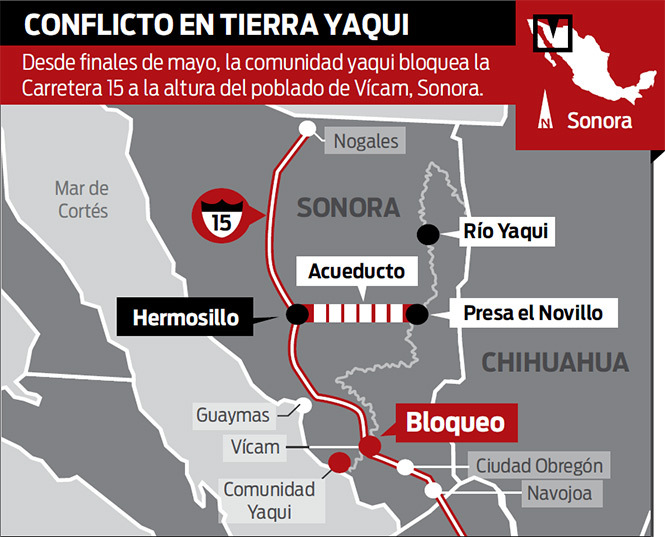
Intermittent blockades of Route 15 have been one tactic used by Yaqui resisters in response to the theft of their water in the last few years. The rapid growth of the City of Hermosillo in the state of Sonora, Mexico situated along the CANAMEX Corridor, on the way to the Port of Guaymas, is due in part to NAFTA-fueled agribusiness and mining which are the primary water-users. As it is, Sonora essentially exports millions of gallons of fresh water to the US in the form of fruits and vegetables. In the context of the drought and overuse of water, and as a result of the ways international trade has impacted Sonora, Hermosillo has required acquisition of water, impacting the Yaquis, Mayos, and Guajiríos with aqueducts and dams on the rivers. These mega-projects, enacted by Sonora SI (started by the Sonoran Governor who has a close relationship with the mining industry), have the intention of addressing the water crisis (for Hermosillo), contributing to the competitiveness of the region and providing new infrastructural projects for companies to make money from.

Since technology is now allowing for relatively affordable removal of salt from the plentiful ocean water, one megaproject planned for Sonora is one or more desalination plants. It is possible that the Agreement of Cooperation between the states of Arizona and Sonora signed by the respective governors at the Arizona-Mexico Commission’s Plenary Session last summer to jointly evaluate the feasibility of desalination at the Sea of Cortez for a new water supply for Arizona and Sonora is related to the Sonora SI project, which includes a desal plant in San Carlos near Guaymas. The potential for desalinated water piped from California or Mexico is part of Arizona's official water strategy. This year, a bill is in the Arizona House of Representatives to fund and arrange a study for the potential for desalination for Arizona. The intention for Arizona to expand and become more competitive in trade, along with potential new copper mine(s) will mean new demand for water, and with the combination of scarcity and new infrastructure, the water could be privatized. Desalination plants threaten the environment in various ways including the direct impact on their location on the water, as well as through the use of energy in the process and transport of the water.

Despite the likely need for drastic measures even if Arizona doesn't grow, some in Arizona find that expansion is necessary and inevitable. A so-called “megapolitan” area including Phoenix and Tucson called the “Sun Corridor” is intended as an economically integrated trade hub along the CANAMEX Corridor. Those interested in this concept have been attempting to reform state trust land law in the interest of further growth and development. The Sun Corridor concept is supposedly justified by—at the same time as it is used to encourage—growth and accompanying infrastructure especially for freight traffic in the area despite that growth is not sustainable in the area. The infrastructure required includes new roads, rail, ports, and border security.

Along with the steps to build Interstate 11, just in the last few months, Arizona opened trade offices in Hermosillo and Mexico City, committed funding to increase freight rail infrastructure near the border and to expand ports of entry at the AZ/Mexico border. According to ADOT's press release, Arizona was involved in a US/Mexico joint investment “implementing U.S. technology, equipment and training to enhance the efficiency of the military inspection station north of Hermosillo," which involves $6.8 million almost certainly from the Mérida Initiative, with an additional $4 million from the Mexican Government.

The primary intention of the Mérida Initiative (also known as Plan Mexico, a reference to the failed Plan Columbia) is supposedly to fight the drug trade, but one major role, to create a “21st Century Border Structure,” deals with trade and migration as well. This is meant to “Facilitate legitimate commerce and movement of people while curtailing the illicit flow of drugs, people, arms, and cash. The Mérida Initiative will provide the foundation for better infrastructure and technology to strengthen and modernize border security at northern and southern land crossings, ports, and airports.” Sure, the US wants to prevent the illicit activity that correlates with increased movement of trucks across the border. It is also the trade policies themselves, and the accompanying poverty and displacement, that contribute to migration (and arguably contribute to the drug trade). Many in US benefit from exploiting the cheap labor created by criminalization of migrants. And then there are the security and technology companies who can profit from infrastructure and equipment involved in securing the border. Large transnational companies such as Israeli company Elbit Systems brings their similar experience in militarizing the Gaza Strip and enforcing their apartheid wall to the border as well. The potential for any future Comprehensive Immigration Reform to bring about a "border surge" manifesting a massive profit-making opportunity for the military industrial complex to the US/Mexico border will likely make it even worse than it already is. Migrants continue to die crossing the border. Tohono O'odham who live along the border or visit relatives also face daily harassment, abuse, check-points, invasion of privacy, limits on movement, drones, cameras, etc. due to the border patrol's activities where the border bisects their lands.

Arizona officials and business leaders want to believe the myth that Mexico has the violence and organized crime under control. In the interest of becoming more friendly to international investment, for just a few years prior to the violent disappearance of the students from Ayotzinapa in late 2014, Mexico attempted to make itself look as though it was successfully instituting the rule of law. Yet law enforcement is clearly involved in much of this violence. And U.S. trade policy is largely culpable. Many violent acts tend to be depoliticized and obscured by associating the victims with drugs. Students at the Normal school in Ayotzinapa were known for protesting neoliberal reforms in Mexico. The fact that they were clearly not involved with the drug trade and that it involved so many youths made what happened to them more worthy of media attention.

The drug war, instead of curtailing the production and movement of drugs, functions, even if not specifically intended to, to facilitate resource-extraction and international investment in areas such as Mexico and Central America. Militarization and paramilitarization benefit US and transnational corporations' involvement there through displacement and social control, as described in Dawn Paley's new book, "Drug War Capitalism." With at least a couple dozen mining conflicts in Mexico alone, and the violence faced by activists who oppose mining, it is clear that even when organized crime groups are involved in law enforcement and violence, these are often acts of repression. For mining to continue, people are forcibly displaced, and the state facilitates this, in part by US tax dollars and to a certain extent for Arizona trade interests. Mining companies around the world often have arrangements with paramilitaries and/or military to protect them, such as in the cases of Resolution Copper's BHP Billiton in Columbia, and Phoenix-based Freeport McMoran in Indonesia.

In modern history in Arizona, displacement looks different but is no less significant. Confiscation of livestock, used as a tactic of attrition to force Diné who have resisted displacement from their lands so Peabody Coal can continue strip-mining the Black Mesa area, has occurred as recently as October 2014. Some members of Congress have recently urged that the relocation project be completed. Arizona's urban areas' access to water and electricity involves a mega-project that has a complex history few know about, which is all the more relevant in relation to the Yaqui water struggle and the potentiality of infrastructure being built for desalinated water. Often characterized as savvy and industrious, the efforts made to create the Central Arizona Project (CAP) that brings water from the Colorado River, and the whole project including Peabody Coal's strip-mining (to fuel the generating plant that powers CAP and provides electricity to Phoenix, Las Vegas and other areas), rests on a history involving manipulation, manufactured conflict between the Diné and Hopi and among tribal members, forced removal of families, contamination and depletion of water, and the poisoning of those who have lived close to the mines and the generating station.

Indigenous people's access to clean and plentiful water has been threatened since settlers arrived, even after they were given priority water rights by the federal government. Not only did Southern Arizona settlers divert water away from sources Tohono O'odham and other indigenous people relied upon, and contributed to erosion of their lands, indigenous people have been swindled for their priority water rights over the the last several decades. The Arizona Department of Water Resources considers the resolution of tribal water rights claims (9 more out of 22 total) the number one priority due to the uncertainty of long-term water availability for Arizona. Often the settlements promise infrastructure to provide water delivered to homes on the reservations, instead of addressing the root causes of poverty and lack of access to clean water. The mining industry consumes and contaminates water on a massive scale, and because of how much water it depends on, is especially interested in securing water rights at the expense of priority water rights held by some tribes in Arizona, such as in the case of Freeport McMoran being involved in the settlement of Hualapai water rights claims last year.

In some cases, mining companies like Freeport McMoran have been buying land for the associated water rights. Freeport and Resolution Copper have benefited from legislation and/or legal exemptions that allow them to essentially hoard water. No doubt the Resolution Copper mine near Superior would use several millions of gallons of water a year. Rio Tinto (of Resolution Copper) has purchased future water rights from CAP. The risk to water in AZ will be compounded if the Rosemont Copper mine near Tucson also gets approved. Access to clean water that is also affordable becomes a grave concern as water becomes scarce, commodified, and potentially privatized as more infrastructure is involved in its acquisition and treatment.

As is implied in "There is No Drought: California's Twisted Waterways," the threat of a serious drought can be used by those interested in profiting off the scarcity of water, and the "solutions" which are proposed are those that benefit these private interests. Obama made water privatization in the US easier, when on June 13 of 2014, he signed the Water Resources Reform and Development Act (WRRDA) into law. This included the Water Infrastructure Finance and Innovation Authority (WIFIA) which is a 5-year pilot program providing financing for P3s for water projects. WIFIA, mirroring the "Transportation Infrastructure Finance and Innovation Act" (TIFIA), was a concept developed and promoted by the American Water Works Association (AWWA). The new director of the Arizona Department of Water Resources was a member of the AWWA.

Additionally, various companies involved in other Arizona infrastructural projects (AECOM, CH2MHill, CDM Smith, Bechtel) are involved in water privatization across the world.AWWA, a non-profit, is supported by CH2MHILL and closely affiliated with AECOM. And with more P3s for transportation, the likelihood for P3s for water increases.

Private interests have pushed for Interstate 11 due to its role in trade. I-11 is also likely to be procured as a public-private partnership (or several). Public-private partnerships (P3), a type of arrangement which we'll be seeing more of in the coming years (and is in the works for the South Mountain Freeway), are proposed as a mutually-beneficial solution that uses complicated financial strategies to leverage state assets and essentially provide federal and/or state subsidies (through tax-free bonds, low-interest loans, etc.) to the private sector. It helps finance projects for which funding is otherwise lacking—therefore it is a much desired arrangement for construction and engineering companies, consultants, as well as banks. The P3 creates new profit opportunities for financial institutions, in the meantime creating more debt, and therefore it is largely about financialization. A P3 can also be understood as a form of privatization, not because a P3-built road would not be publicly accessible, but because P3s afford private entities influence, agency, and financial deals they would otherwise not have access to. Projects such as roads are more likely prioritized based on the interest of private parties, and based on what is incentivized by the federal government. A public-private partnership could also refer to an organization ("P3 unit") that involves public officials and private members, creating new forms of governance that provide opportunities for private involvement in decision-making.

Two such P3 units of note in Arizona are the Arizona-Mexico Commission (AMC) and the Transportation and Trade Corridor Alliance (TTCA). Both of these organizations involve the Director of the Arizona Department of Transportation and other state officials as well as various corporate leaders, with much overlap between the two. The pro-NAFTA AMC, who takes credit for pushing CANAMEX along, seems to have had a lot to do with getting TTCA instituted and becoming a major influence in Arizona policy on trade and transportation in recent years. Freeport McMoran has been a major sponsor of AMC and has had someone on the board of directors for several years. The locations of Freeport's Arizona mines and their use of the Port of Guaymas correlates with their interest in CANAMEX and I-11. Freeport hired the last director of the Arizona Department of Water Resources as their water strategist, and this department now has an intimate relationship with AMC, even listing AMC

It is no surprise as well that Senator John McCain has been a large proponent of the land swap for Resolution Copper, the Mérida Initiative, increased trade with Mexico, and the TPP. But this goes far beyond him and the AMC. Across the world, the World Bank and IMF have coerced countries into adopting structural adjustment programs or other changes in exchange for access to loans. We may be aware of austerity measures in the US, but we may not realize the various ways in which Arizona (or other US states for that matter) is also impacted by state-enabled free market ideology even as the state is not forced into formal agreements to open new areas up to private "partners." The economic development, made to seem intended to create jobs and improve the livelihoods of citizens is about nothing more than accumulation of wealth. It is clear though, that whether we call it neoliberalism, capitalism, or colonialism, is also a project of the state.

Thursday, January 9, 2014

Plunder Road: CANAMEX and the Emerging Impact of NAFTA, TPP on Western North America


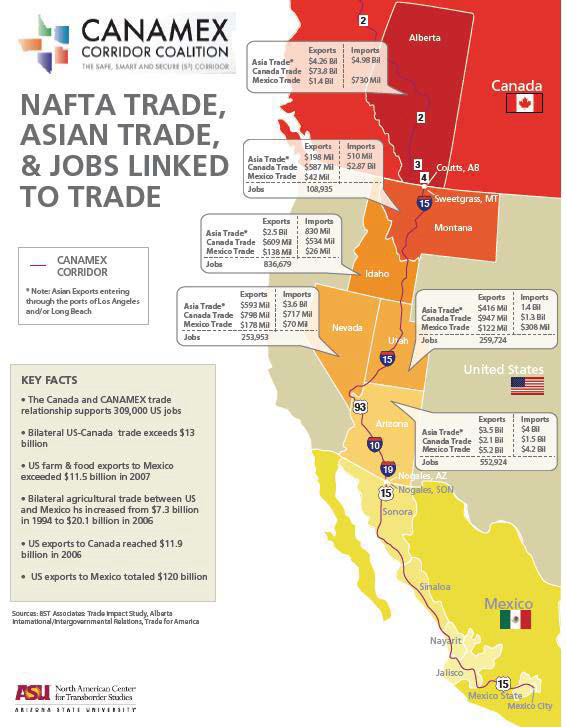
As people across the world honor the twentieth anniversary of the Zapatista Liberation Army rising up in response to the implementation of the North American Free Trade Agreement (NAFTA), resistance continues, most notably against resource extraction and other infrastructure. Meanwhile, what some call “NAFTA on steroids,” the Trans-Pacific Partnership (TPP) is currently pending agreement involving the North American countries and others scattered around the Pacific. And rather quietly, a transportation project called the CANAMEX Corridor is underway to facilitate trade along a north-south corridor of western North America. This corridor runs from a port on the Pacific coast of Mexico, through Arizona, Nevada, Utah, Idaho, Montana, and north near the Tar Sands in Alberta, Canada.

Opposition to the CANAMEX Corridor is necessary not only because it is a major piece of the physical infrastructure needed to facilitate this trade. Its function in international trade is also used to justify the damage brought by its imposition locally, throughout the corridor. CANAMEX, designated as a High Priority Corridor shortly after NAFTA was implemented, already exists in the form of highways, but requires improvement and expansion to effectively facilitate trade.

The trade corridors of North America, CANAMEX being one of them, are extensions of NAFTA. They function as the infrastructure, such as roads, rail, ports, etc., that perpetuates the harms caused by so-called free trade. Among the effects of NAFTA since its implementation have been dramatic unemployment and displacement in Mexico due to subsidized US agricultural products such as corn, and a shift in privatization/ownership of Mexican land by private interests. One of the worst environmentally damaging projects in the world is the Tar Sands extraction in Alberta, Canada, which is in operation at its current level largely due to the NAFTA obligations to supply oil to the US. CANAMEX would also be an important corridor of TPP trade due to its Pacific seaport in Guaymas, Mexico, and its proximity to the west coast in general.

The impact of CANAMEX involves displacement of people and destruction of sacred sites and the environment, thereby affecting indigenous communities and various others. Trade transportation infrastructure is necessary for free movement of goods across borders, but along with it must come heightened border security in response to displacement caused by the impacts of trade agreements. Because it requires fuel, trade infrastructure is one of the primary reasons for resource extraction and is an extension of colonialism. Additionally, it is justified and imposed locally in the form of development and sprawl with compounded reliance on energy and resources such as water.

A project increasingly being used to circumvent the obstacle of lack of funding for these trade corridors is called a public-private partnership (P3), which is an arrangement that is essentially privatization but with some state control. Having been utilized throughout the world, P3s in North America seem now more than ever to go hand-in-hand with trade infrastructure development and neoliberalism in general.

In simple terms, neoliberalism involves trade liberalization, privatization, and relaxation of state power in effort to allow for a free market economy. It is important to frame opposition to the practice of neoliberalism and its trade pacts, privatization, etc., by foremost addressing state collusion and repression, in addition to its form as an extension of colonialism and capitalism. State repression against resistance makes possible the ease with which these colonial/neoliberal projects expand.


Trade and Resource Extraction

In December 2013, tens of thousands of Mexicans demonstrated against the recent decision by the president to open oil and gas reserves to foreign investment, the implications of which, due to NAFTA and TPP, are predictably negative for the people. Up in the north, Nez Perce, Umatilla, and Warm Springs tribal members, and Rising Tide members, among others, have partially stalled attempts to transport massive pieces of equipment called “megaloads” to the Tar Sands in Alberta over the last couple of years with various protests along the route from ports in the northwest US to the Tar Sands. By no coincidence, Interstate 15, which is part of CANAMEX, will possibly be used to transport megaloads north from where the 90 meets it in Montana. Expansion of trade transportation infrastructure is dependent on resource extraction and vice versa. Trade corridors provide the infrastructure for the movement of this type of equipment and could additionally facilitate future extraction at the tar sands in Utah, which is not very far from the CANAMEX Corridor. Rail may possibly be a significant mode of transportation of crude oil in the near future, especially with obstacles, largely due to grassroots resistance, to the construction of pipelines.

The CANAMEX Corridor is one expansive piece of the physical infrastructure of NAFTA and potentially the TPP. Even though the TPP does not seem primarily to emphasize trade as much as one might assume, it is undoubtedly the case that increased trade traffic will have an impact along the corridor, in the form of prioritization of transportation projects, and shifts in policy.

Citing the problem of bottlenecks in trade ports on the US west coast, CANAMEX-proponents favor trade products entering North America through western Mexican ports such as the Port of Guaymas, the southern-most tip of the CANAMEX Corridor, which is due to double in size in the next couple of years, making it the second largest seaport in Mexico. The benefits (for capitalists) of receiving trade shipments there, rather than in the US, are multiple aside from avoiding the bottleneck problems. Dockworkers in Mexico have lower wages, lesser benefits, and fewer safety measures than union workers in the States.


In his commentary as the Arizona-Mexico Commission’s CANAMEX expert, Jim Kolbe stated that trade with Asia will likely continue to increase and CANAMEX is meant to facilitate the movement of those goods into Arizona. This was discussed years prior to official TPP talks. Certainly if the agreement goes forth, trade with Asia will grow even more.

Currently, talks on the TPP involve Australia, Brunei, Canada, Chile, Japan, Malaysia, Mexico, New Zealand, Peru, Singapore, the United States, and Vietnam. Not only are Chinese wages lower than Mexican wages, but the wages in Vietnam are half to a third of that of Chinese workers. The ramifications of this could involve increased unemployment and lowering of wages in Mexico and the US. Clearly some of these countries, or specifically their corporations, could easily take advantage of some of the other countries. For example, aspects of the TPP would make it even easier for companies to wreak environmental havoc wherever they choose; saving money on measures that would otherwise limit pollution.

There are various benefactors of the broadening of trade pacts and expansion of infrastructure. Describing the web of connections behind these neoliberal projects would take pages and could look a bit too much like conspiracy theory. We do not need a conspiracy theory to see how neoliberalism works and to understand that certain powerful individuals, corporations, and their organizations are going to have their hands in projects that promote their causes. Elsewhere, I have drawn connections between NAFTA, the Council of the Americas, North American Business Council, Security and Prosperity Partnership, North American Competitiveness Council, UPS and other corporations, McLarty Associates and its member Jim Kolbe who is part of the Arizona-Mexico Commission and the new Arizona Transportation and Trade Corridor Alliance which encompasses the Governor’s CANAMEX Task Force. Exposing these networks can be useful to show that these projects are being imposed by a wealthy few.

On a more local level, certain organizations and businesses are seeking expansion of “inland ports” consisting of multi-modal transportation nodes and foreign trade zones (FTZ) especially along trade corridors like CANAMEX. In regions zoned as FTZs, businesses get tax breaks and duty exemptions and deferrals. The placement of these FTZs will serve to justify infrastructure for this trade traffic to and through these areas. The presence and authority of the Customs and Border Protection (CBP) in these foreign trade zones have unknown implications for migrants within them.


Trade and Border Security

On May 21, 2010, protesters locked down at the Border Patrol Headquarters in Tucson, Arizona with demands for self-determination for indigenous people, to regularize (“legalize”) all people, and for an end to NAFTA, among many related general and specific demands, which were and continue to be lacking from other similar actions. Involving members of Indigenous Nations of Arizona, migrants, people of color and white allies, it represented a more cohesive and radical analysis of the interlocking impacts of border security and trade.


Despite NAFTA being sold as a way to increase job opportunities in all three countries, the timing of beefed-up border security such as Operation Gatekeeper in the San Diego area, launched in 1994, indicates that the US government knew that NAFTA would cause an upsurge in migration from Mexico to the US due to the economic impact. On the surface it seems contradictory for Arizona to promote further NAFTA (and TPP) trade while enforcing immigration law. Yet capitalists and their government collaborators simultaneously want goods to move freely across borders and they want people moving across those borders to be criminalized and limited, thereby making them more exploitable. Governor Jan Brewer, for example, enthusiastically signed SB1070 and is promoting CANAMEX through the Arizona-Mexico Commission and the new Transportation and Trade Corridor Alliance.

This is not to imply that SB1070-style immigration enforcement is the preferred type. In fact, many would prefer some level of legalization, particularly guest worker programs, but either way it would be a “solution” with an emphasis on border security, and certainly not something that addresses the root causes of mass migration.

Border security will increasingly militarize O’odham communities in Arizona, coinciding with the invasive development and construction of trade infrastructure (roads, ports of entry, foreign trade zones) involved with CANAMEX. In Arizona, various freeways, or possibly toll-ways, comprising (or in close proximity to) the CANAMEX Corridor might be built through or along reservations and/or sacred sites, such as the Loop 202 Freeway extension in Phoenix, slated to cut through South Mountain which is sacred to O’odham. Construction of the wall, border-patrol harassment (and reckless driving), check-points, cameras, drones, severe limits on movement across the border for ceremonies (or for any reason), are some of the impacts of border security on O’odham and others living near the border—repercussions that would only worsen if/when Comprehensive Immigration Reform were to pass as proposed. CIR fans clearly ignored the escalating detriment it would create for border communities and recent/future border-crossers, and have largely failed to even mention the root causes of mass migration such as NAFTA.

CANAMEX-promoters are selling their development projects as ways to increase job opportunities, as did those hyping NAFTA in the ‘90s. However, the so-called free trade pushed by neoliberals has contributed to a hike in out-sourcing of jobs from the US. Rather than blaming the companies moving their facilities to countries with cheaper labor while continuing to pay their CEOs extravagant sums, it is the migrants who are scapegoated for the loss of jobs in the US. And while migrants are also blamed for taking advantage of welfare in the US, criminalization of migrants essentially acts as a form of welfare for the rich in that it maintains a permanent underclass of exploitable undocumented workers making wages, goods, and services cheaper. Without state repression, this situation would look far different.


Trade, Colonialism, and Sprawl

Unist’ot’en, Wet’suwet’en, and their allies continue to resist the imposition of various pipelines being planned to cut through unceded Wet’suwet’en Territory in northern British Columbia to link the Tar Sands to the west coast for trade with Asia. Down south in Mexico, the Council of Ejidos and Communities in Opposition to La Parota Dam (CECOP) and guerrilla group Fuerzas Armadas Revolucionarias-Liberación del Pueblo (FAR-LP), continue to resist La Parota hydro-electric dam intended to provide water and electricity to the Port of Acapulco. There are numerous other examples of opposition to the slew of negative impacts of the Athabasca Tar Sands project, against the Keystone XL Pipeline and countless other pipelines, movement of megaloads, development of the Utah Tar Sands, numerous fracking sites, and on and on. These and other forms of resistance are met with state repression. The physical infrastructure of neoliberalism such as highways, mines, pipelines, dams, etc. embody the continuation of colonialism. The plunder results in destruction of indigenous ways of life, displacement of people, and detriment to their health.

Every community the trade corridors cut through is affected by it. To the extent that people are even aware of the intentions meant for their local area, decision-makers may simply promote whatever benefit to the economy that might supposedly be brought by trade traffic. There are bigger plans at work, however. In the so-called Sun Corridor, expanding development, trade infrastructure and policy changes are justified by supposed population growth in general, and promises of prosperity that ideologues of regionalism are using to entice state leaders to embrace CANAMEX. The growth is forecasted by academics and others associated with organizations such as the Brookings Institute, the Morrison Institute working with Arizona State University, and companies such as AECOM promoting the concept of the Sun Corridor. The Sun Corridor is the name for this so-called megapolitan or mega-region consisting of Phoenix and Tucson (and possibly Prescott and Nogales), and making up part of the CANAMEX Corridor. ADOT and other transportation committees have taken this concept of the megapolitan, an economic integration of nearby metropolitan areas that are expected to reach 10 million residents by 2040, as inevitable. The Federal Highway Administration website also includes megapolitans in discussion on planning.

Increased sprawl in the so-called Sun Corridor is generally unpopular. Various communities oppose highways due to environmental impacts on the air, animals, plants, climate, and health. Additionally there are concerns about accidents involving dangerous cargo, and noise pollution. While highways are thought of as a way to improve movement, to the local community they often has the effect of a wall, dividing neighborhoods (not to mention demolishing homes and other places of importance) and often involving actual walls (which helps with noise pollution, but one would rather have a view of the mountains than of a wall). In the case of the Loop 202 Freeway extension, the above issues apply, along with concerns regarding threats to the O’odham way of life and sacred sites. Even if this proposed road isn’t part of the official CANAMEX Corridor, it is meant to support Sun Corridor sprawl and trade traffic.

Often the issue of sprawl or the requirement for expansion is framed as a problem of over-population primarily blamed on immigrants. This blame often functions to shift the responsibility away from massive resource-extraction projects that use water, energy and other resources (a never-ending cycle); use of fuel in trade-related shipping; irresponsible and inefficient planning and expansion; etc. This expansion and required resources is pushed by neoliberal academics and consultants, and even small-time real estate developers, resulting in over-consumption. Applying the label of “sustainable” or “green” to their projects makes it seem that they are doing this responsibly. Water is a particularly volatile issue, threatened by pollution from energy extraction, use of massive amounts in these projects, climate change, and the requirements of supporting the consumption involved with sprawl.


Neoliberalism and Public Private Partnerships

The public-private partnership (PPP or P3) is becoming increasingly more common in North America. Researching the P3s being discussed locally or globally for an infrastructure project is definitely a useful way to follow the money. It should be clear, however, that this type of arrangement is not in and of itself the problem (see most other imposed projects prior to P3s), but the problem is that it carries with it new and more insidious problems.

The main organizations promoting CANAMEX – the Arizona-Mexico Commission (the “godfather” of CANAMEX) and the new Arizona Transportation and Trade Corridor Alliance (TTCA), which is said to encompass the Governor’s CANAMEX taskforce – are both entities comprised of public and private members, with overlapping membership between the AMC and TTCA. The weight of their influence is uncertain, as they are not official decision-making bodies although there is also overlap with government committees. Sometimes an organization like this is referred to as a P3 or a “P3 Unit.” An example of a better-known P3 Unit is the American Legislative Exchange Council (ALEC), exposed in 2011 for its facilitation of collaboration between private prison companies and state legislators, resulting in the proliferation of SB1070-type anti-immigrant laws.

P3s more often refer to business arrangements between the state and private companies, often to build infrastructure and/or to manage a utility or service. P3s have been implemented across the world, primarily in cases where countries are indebted to neoliberal institutions. A lot of water privatization programs across the world are actually P3s. Along the lines of austerity measures, these arrangements in North America are not unlike structural adjustment programs (SAP) mandated in countries in debt to the World Bank or IMF. But while SAPs are largely involuntary, public-private partnerships in North America for projects such as transportation, are being promoted voluntarily as “innovative financing” by many government officials in cahoots with private interests. Compared to total privatization, an arrangement in which the government remains in so-called partnership with private interests makes the scenario easier to stomach for the residents affected, yet the private interests profit while the state government, or more specifically taxpayers, are left in debt to the companies for decades.

Arrangements such as these have been increasingly pushed by neoliberal organizations such as the Security and Prosperity Partnership and its successors, partly to promote the idea that the private sector is more efficient in projects such as for infrastructure, partly because various businesses want to make a buck, and because the funding is not available for these projects that are supposedly needed. The needs of the public are being defined in many ways by private interests such as construction businesses, real estate developers, trucking companies, banks; and in the case of international trade corridors, investment firms, and especially neoliberal think-tanks and consulting services, who often have ties to NAFTA and SPP and/or big banks. A little web research into who the members of P3 organizations are, and who is attending or sponsoring P3 conferences, reveals how steeped in the trend various public officials and big construction companies are.

If a company or companies see dollar signs in a particular project, this project is likely to be prioritized by the state, as in the case of trade transportation, for example. Many people do not even know about the plans for CANAMEX and its freight truck traffic, yet the roads that would facilitate this trade flow are being promoted (by politicians) as useful to the residents of the area in question. New transportation legislation like MAP-21 and institutions such as the Federal Highway Administration encourage and help facilitate public-private partnerships for transportation projects. Private conglomerates can potentially take advantage of loans (such as TIFIA loans) and tax breaks that the state would access. Sometimes in conjunction with, but often in lieu of toll roads, the private companies would receive availability payments, which ultimately come from taxes.

This information became relevant in Arizona when a business conglomerate proposed a P3 to build the Loop 202 South Mountain Freeway extension in Phoenix in 2012. Legislation is in place in Arizona for a range of P3 arrangements and Arizona Department of Transportation is salivating for a good P3 deal in transportation.

These public-private partnerships, along with the so-called free trade pacts, are the brainchildren of neoliberalism. Often in discussion on neoliberalism, the political Left presents false dichotomies between privatization vs. the commons (held by the state), and regulation vs. deregulation. While regulation might mean keeping private interests from doing more damage, it encourages a reliance on the settler state to protect the people, meanwhile diverting attention from the ways in which the state has perpetrated harm against the people from its beginning, and has hardly been neutral regarding the interests of the rich. Although perhaps ideologically inconsistent, in practice neoliberalism relies on collaboration between state and the private sector to provide privileges to those private interests in the form of defense and security (police, military, prisons, border security), tax breaks, subsidies, access to information, prioritization, and promotion of private plans. While lobbying dollars and such likely have a lot to do with it, this is not corruption; it is the role of the state in this latest form of capitalism. Capitalism has always involved power and force; neoliberalism just comes in a different form. In this sense, it does not matter the extent to which a project is privatized or neoliberal if it harms people, but the focus is on neoliberalism because it is the primary modern economic form particularly in relation to infrastructure.


CANAMEX Development

The naming of the concept of the CANAMEX Corridor goes back at least to 1993 just prior to the passing of NAFTA, followed by the designation as a High-Priority Corridor by congress in 1995, and implementation of the Arizona Governor’s CANAMEX Task Force in 1998. The Arizona-Mexico Commission (AMC), now along with the TTCA, seems to be the main promoter of the corridor.


The route given for CANAMEX, which is subject to change, involves Mexico Federal Highway 15 in Sonora connecting the Port of Guaymas with the US border in Nogales; State Route 189, Interstates 19, 10, and US Route 93 (and now Interstate 11) in Arizona; Route 93/Interstate 11, Interstates 515 and 15 in Nevada; Interstate 15 through Utah, Idaho, and Montana; then a complicated route involving the following highways in Alberta and British Columbia: 4, 3, 2, 216, 16, 43, 2, and 97.

For a while, it seemed like there was some sort of hiatus on the project, likely due to the economy. However, things picked up in 2012. Currently the primary project within the CANAMEX Corridor is Interstate 11, which is in the study phase. It is meant to provide transportation for freight traffic for which the US Route 93 between Las Vegas and Phoenix is inadequate. In fact, many news articles seem to refer to Interstate 11 interchangeably with the often-unnamed trade corridor stretching from Mexico to Canada.

The Moving Ahead for Progress in the 21st Century Act (MAP-21) designated this route as Interstate 11 in 2012. Part of what would be Interstate 11, phase one of the Boulder City, a.k.a. the I-11 Loop, is currently in the works. Phase two will connect with the Hoover Dam Bypass which was completed in 2010. A public-private partnership involving a toll road had been a possibility for the Boulder City Bypass in Nevada but this idea was abandoned mid-2013. Instead a gas-tax increase would fund the construction. Public-private partnerships, possibly including tolls, are being discussed for implementation of other parts of Interstate 11. In fact, despite this being a priority corridor, some experts have stated that most new projects would require a P3 or won’t be built at all due to lack of funding.

The Arizona Transportation and Trade Corridor Alliance (TTCA), in conjunction with Pima County, is talking about southern Arizona connectivity, and therefore Interstate would not only connect Las Vegas with Phoenix, but extend through Tucson and Nogales.

Ports of entry along the borders will likely be expanded for easier movement of goods, in addition to seaports such as the Port of Guaymas in Mexico which is the southern tip of the CANAMEX Corridor, due to double in size in the next couple years. The Corridor also involves rail, fiber optic telecommunications, and possibly pipelines.

The CANAMEX Corridor is an important part of NAFTA (and possibly TPP) trade, and as such, is a weak point of globalized infrastructure according to the strategic campaign Root Force. The promise of economic prosperity is used as justification for the imposition of trade infrastructural projects throughout the corridor. Discussion on these “NAFTA Super-Highways” has been dominated by right-wing conspiracy theorists concerned about US sovereignty. It is important to shift the debate towards indigenous sovereignty and solidarity, towards an end to capitalism rather than just a reaction to economic integration, towards an end to resource extraction projects, towards an end to state repression and the state in general.


See stopcanamex.blogspot.com for more info.

Thursday, June 28, 2012

Raúl Alcaraz Ochoa: Beyond the BS1070 Supreme Court Ruling

Beyond the BS1070 Supreme Court Ruling:
“Not even the highest court can turn back a determined people!”

By Raúl Alcaraz Ochoa / 25 June 2012

This can’t be said any other way. Our migrant/Latino community is getting crushed. In fact, we are getting stomped on and beaten like a colorful piñata. The piñata is electoral and the more they hit, the more political points are scored—at our expense.

On the surface, the political class wants to make us think they are at war with each other over immigration. When in reality we have a US Supreme Court ruling over BS1070 that is in complete alignment with Republican and Democrat immigration policies of exclusion, exploitation, and police and ICE collaborations.

In the wake of the US Supreme Court ruling, injustice and oppression are upheld once again. The “papers please” section of BS1070 has been upheld. In effect standing in the tradition of white supremacist historical Supreme Court decisions such as Dred Scott v. Sanford of 1857 in which the court ruled that slaves and their descendants were not protected by the Constitution and were not US citizens...

Read more...

Friday, June 1, 2012

PCWC: JT READY IS DEAD: FASCISM AND THE ANARCHIST RESPONSE IN ARIZONA, 2005-2012

JT READY IS DEAD: FASCISM AND THE ANARCHIST RESPONSE IN ARIZONA, 2005-2012 ~ Fires never extinguished: A blog of the Phoenix Class War Council

JT Ready is dead.  And by his own hand.  It took a while, but in the end JT took the free advice of his many anarchist adversaries and followed his leader into oblivion.  Though in the end he opted for the Goebbels style over that of his boy Hitler.  That's the thing with JT: despite being a consistent white supremacist, he could sometimes surprise you.  Not with something entirely new.  No.  But with variations on a theme.  Most of us figured he would blow up somewhere, at some point, and given the history of white supremacists with regard to child and spousal abuse, we are not surprised that his end mimicked his political practice perfectly: violence mostly aimed down the social hierarchy. Consider the death of National Socialist Movement leader Jeff Hall as another case in point.

According to the cops, on Wednesday, May 2, JT, a former president of the Mesa Community College Republican Club and Maricopa County Republican precinct committeeman, stormed the house of his much-abused and terrified girlfriend in Gilbert wearing full combat gear and then proceeded to open fire on everyone in the place.  The dead included Lisa Mederos, her daughter Amber (JT's former treasurer for his run for Pinal County Sheriff), as well as her fiance, Jim Hiott, who was a fellow militia member.  In a truly cowardly act, JT also killed Amber's 15 month-old baby.  Only Lisa's younger daughter survived, hiding under the bed in her upstairs room.

We in PCWC first began running into JT during the early parts of the immigration movement, around 2005, before there was a formal PCWC, really.  As many probably know, JT had a rather chaotic political career, but in those days he was allied with State Senator Russell Pearce and local car dealer Rusty Childress.  Even then political violence had already begun to rear its ugly head in the anti-immigrant scene.  It might be valuable to review some of what had happened in Arizona in the several years preceding JT's final bloody rampage, and it certainly would be worthwhile to consider the ways that anarchists in Phoenix and Arizona organized against him, his politics and his political allies (and enemies) over the last half decade or more.  While liberals advocated for his free speech, anarchists opposed him every step of the way.

Read more: http://firesneverextinguished.blogspot.com/2012/06/jt-ready-is-dead-fascism-and-anarchist.html

Wednesday, April 4, 2012

Feds to Sue Arpaio, but Carry Out Largest National Round-up Yet

It may seem like great news that the federal Justice Department will finally be suing sheriff joe.  According to "Government plans to sue Arizona sheriff for targeting Latinos",
The administration's Justice Department and the Maricopa County Sheriff's Office have been in settlement talks for months over allegations that officers regularly made unlawful stops and arrests of Latinos, used excessive force against them and failed to adequately protect the Hispanic community.
Those negotiations have broken down because of a fight over the Justice Department's demand that an independent monitor be appointed by a federal court to oversee compliance with the settlement...
But can the federal government really take the moral high ground when you contrast the latest round-up, which happens to be the largest yet, with sheriff joe's sweeps?  In Colorlines' "ICE Arrest 3k Immigrants in 6 Days, Largest Roundup Ever", the raids are described:
On Monday, U.S. Immigration and Customs Enforcement (ICE) announced 3,168 undocumented immigrants were detained over the course of six-days in a national operation the agency dubbed “Cross Check.” According to ICE, the six-day operation was the largest such effort in the agency’s history.
I find it interesting that I hardly saw any mention in my social media networks about this largest round-up ever.  Arizonans in particular seem to think that the federal government could and would save us from horrible politicians like Arpaio.  The Federal government prefers to think of their work as colorblind, that what sets them apart from Arpaio is that he is actively discriminating which "erodes the public trust," according to Napolitano.  I snarkily commented in last December's post, "Federal Goverment Prefers Their Way Better Than Arpaio's", "because blatant maliciousness and hypocrisy erode the public trust, the status quo doesn't."

The following points really contextualize the federal government's approach:
“The raids are in line with the administration’s record on immigration to date: while claiming to target serious offenders the majority of those detained were in fact people with misdemeanor convictions and people who’ve returned to the United States after having been deported previously. In the case of the later group, many have returned to the United States to be with their families,” [Colorlines.com’s investigative reporter Seth Freed] Wessler went on to point out.

In it’s press release, ICE again claims that the agency “is focused on smart, effective immigration enforcement that targets serious criminal aliens who present the greatest risk to the security of our communities.” And the Washington Post reported the news with an inevitable highlights reel, naming a Cameroonian drug distributer with a gun charge and Mexican murderer among the group. “But of course, the vast majority of those in the serious criminal list are not kin-pins and murderers. ICE officials continue to draw on racialized hysteria to naturalize what’s clearly a bald policy of mass deportation,” Wessler said.

Wessler also notes operation Cross Check is the third such national scale enforcement operation in the last year, which together have detained nearly 8,500 people. “These numbers amount to only a fraction of all deportations. Last year nearly 400,000 people were deported.”
Read that last paragraph again.  As I have pointed out in the past, the federal government does not create elaborate press circuses to feed their ego, accompanied by veiled racist rhetoric, quite the way Arpaio does.  But let's be honest here.  The federal government is doing the majority of the detaining and they're doing all of the deporting.  It has been over three years since I wrote, Federal Government will not be Maricopa County's Savior in response to the announcement that the House Judiciary Committee was pushing Eric Holder and Napolitano to investigate Arpaio.  I pointed out that "Much of the activism is focused around getting people from the federal government to pay attention, although others also call on the federal government to stop the raids. The primary voice of immigrants’ rights advocacy in anglo media is Stephen Lemons who recently said, 'The political reality of Cactus Country is this: Without intervention from the Obama administration, we are royally screwed.'"

In further commentary, I wrote,
We cannot expect a government that has been built on racism and continues to practice it in various ways (much higher rates of incarceration of people of color than whites, lack of indigenous rights, wars, just to name some examples) to be a force against white supremacy. The operator of immigration detention centers (or the ones who outsource private detention facilities), the performer of raids, is not the one whose going to save us from the similar actions of the Sheriff. He is doing their work for them. He's just doing it in an extra "look how demeaning i can be to these people" way. If the federal government does anything about it, it will only be to legitimize and continue its own actions and those of other jurisdictions.
The federal government is the reason why stepping across a man-made line or overstaying a visa are illegal in the first place.  They are they ones who have forced programs like Secure Communities onto city and state governments.  Arpaio just pushes the limits to see how far and blatant it can go.

It seems in some ways that Arizonans are still waiting and hoping for some federal intervention.   Considering the actions of the federal government, however, does this not seem rather ridiculous?  Not to mention that treating the lawsuit against Arpaio as a victory distracts from the major problems that continue to occur.

Edit:  See also: Operation Cross Check » Counterpunch: Tells the Facts, Names the Names.

Thursday, December 1, 2011

ALEC Protests: Any more radical than Bush protests?

Considering that ALEC has not been shut down (yet?), I'm concerned that some of the message has been lost in the interest of gaining numbers and exposure. I do think it's important to expose ALEC, and that has been accomplished on a large scale over the last year, with this protest in Scottsdale being the largest and most militant yet.

I've been concerned about ALEC being the new public enemy #1 when in fact they are just a good example of the larger system(s) at work that affect laws to the benefit of the rich and powerful. So we're talking colonization, capitalism, slavery and the continued criminalization of people of color, which included borders and prisons, etc. There certainly are benefits to the exposure of the World Trade Organization (WTO) culminating 12 years ago, but in a sense, it focused on neo-liberalism/globalization at the expense of a focus on capitalism.

While ALEC came to be exposed to us in AZ because of its links to SB1070 and private prisons, I was concerned that the private-ness of prisons would be the focus, rather than the history of criminalization people, primarily people of color, which has also benefited the rich and powerful. But while I don't know a lot about the messages coming out of the liberal/progressive/democrat groups that are also opposing ALEC, it seems that even the private prison connection is not the main focus. And with the occupy rhetoric, ALEC can just be understood as representing the 1%.

Today I asked myself what made these ALEC protests different than the old Bush protests where democrats and anarchists gathered together to oppose a common enemy. Not to say we shouldn't oppose a common enemy, but it is clear to anarchists (for the most part) that democrats can be just as bad if not worse in their slimy deceptive ways. Or they don't have to be deceptive, it's that those who would oppose Obama's higher rates of raids and deportations are more isolated because the left is too afraid or enamored to oppose Obama. It's similar to how Arpaio has been the face of evil anti-immigrant schemes, while the Phoenix PD has made more arrests than MCSO and with hardly a peep from the immigrants' rights movement.

All this is intended as constructive criticism and self-criticism. What is it that we'll wish we had done differently, and is it to late? The indigenous gathering was very encouraging. There will be more media releases that address the wider context. It was great that the "SHUTDOWN ALEC" message did not alienate many people, even if it hasn't resulted in the achievement of that goal. I hope that now that ALEC has been further exposed, we can bring the bigger issues into the forefront. Because if ALEC didn't exist, there would still be prisons, borders, colonization...

It's the never-ending conundrum: say what only anarchists will say at the risk of total isolation, or compromise a bit in hopes that people will slowly be drawn towards being open to what only anarchists will say. I honestly fall somewhere in the middle of these, but sometimes more towards the former.

See also: ALEC protest Wednesday
ALEC in context...
Private Prisons in a Wider Context: Video

Sunday, November 27, 2011

ALEC protest Wednesday

Check out http://azresistsalec.wordpress.com for more info.

Wednesday is November 30, which is the 12th anniversary of the WTO protests in Seattle.  It's also the first main day of the ALEC States and Nation's Summit in Snottsdale.  This is the Summit at which two years ago they agreed upon SB1070 becoming one of their many pieces of model legislation, which corporations and legislators collude on propagating across the country.  In the case of SB1070 and legislature before it (three strikes laws, mandatory minimums, etc.), the three largest private prison companies in the country were involved in the discussions.  It also turns out that various companies involved in resource extraction are also involved.

I haven't spent much time on the details about ALEC because ALEC is just an example of what happens on a large scale, everyday and with a long history.  There are many horrible things about ALEC, but they didn't create the border wall, they didn't build the prisons.  Sheriff Joe's jail is as bad or worse than any private prison or detention center, with the temps reaching 117 in tent city this summer.  When I first learned about ALEC last fall, i wrote What came first: the Racism or the Profit Motive? which i would write a bit differently today, but has some important questions within.   Now i would answer that question by describing it as an intricate combination of the two. I do believe that people will try to profit off something that is already happening, as in the case of private prisons, and that they do try to shape how we see different populations so as to justify criminalization (not to mention the ways that other interests seek to justify exploitation- and this is justified partly through criminalization). But i also think that there is a history of racism that this concept of privatized prisons is built upon. Yet at the same time, as i discussed, this racism is built on a desire for stability for the rich and has ultimately resulted in a divided working class that could not rebel in unity, and therefore could not successfully rebel.

Based on this, i was motivated to create this video, which is explained further at this link: Private Prisons in a Wider Context (maybe you watched part one, but did you watch part two?). It brings the focus more towards a historical arc that incorporates colonization, the criminalization of slaves then ex-slaves, and the continuation of criminalization of people of color. This doesn't have to be directly for profit as in the case of private prisons.

Anyway, hope to see you out at the ALEC protest events (there's more going on than just wednesday by the way).

Sunday, August 14, 2011

ALEC thinks they're meeting in Scottsdale, AZ this November...

ALEC thinks they're meeting in Scottsdale, AZ this November...
 
The American Legislative Exchange Council (ALEC) is a massive non-profit body that brings corporations and legislators together to draft "model" legislation.  For example, AZ Senator Russell Pearce and Corrections Corporation of America (CCA), the nation's largest private prison firm, have been members for years.  ALEC finalized the model legislation which became, almost word for word, Arizona's SB1070, aka "Support Our Law Enforcement."  It's the latest in the historical pattern of colonization, slave codes, convict leasing, and the drug war, that CREATES crimes and therefore criminals, for profit.
 
With British Petroleum (BP) and the Koch brothers as some of their funders, ALEC has pushed for Three Strikes and Mandatory Minimum sentencing, as well as the Animal Enterprise Terrorism Act.  More than 200 of ALEC's model bills became actual laws throughout the country over the past year.

We're a group of people in occupied Indigenous lands, now called Arizona, who demand the end of SB1070 and 287g, the criminalization—and then the incarceration—of migrants, and the militarization of the border. We oppose private prisons, detention centers, and security companies, not simply because they are private, but because we are sickened by profiteering on human misery.   ALEC desires "free markets" and "limited government," which means they use the state to support profit-making, the continuance of colonization, and neo-liberal policies (NAFTA, CANAMEX, etc.) that draw lines, make laws, and build freeways and prisons to exploit labor and the earth.

Whether maintained by the state or corporations, we're against all systems of control.  We are for freedom of movement for all people.
 
ALEC should know there are a million better things to do with their time than plotting mass incarceration.  But there’s nowhere we’d rather be than confronting their meeting. We're calling for four days of action here in occupied Onk Akimel O’odham lands from November 29th - December 3rd, 2011, with an emphasis for action on November 30th (N30!).  We encourage a creative diversity of tactics on N30, the 12th anniversary of the Seattle uprising against the WTO.  No matter the acronym, ALEC is no different than all the other gangs of businessmen, politicians, and bureaucrats that we’ve been resisting for over 500 years.

In solidarity with everyone locked up and locked down in AZ, and all O’odham, Yaqui, Lipan Apache separated by the border, and anyone dispossessed by the wealthy and powerful… 

Project Baldwin
projectbaldwin@riseup.net


see also: azresistsalec.wordpress.com

Monday, July 4, 2011

Beware the Funders of Immigrants’ Rights

What would make a giant foundation headed by rich people be interested in donating money to so many groups promoting social justice? What’s Ford Foundation’s interest in all the immigrants’ rights non-profit organizations that are involved in Arizona (and beyond)? While a member of the Board of Trustees at Ford Foundation is simultaneously on the Board of Directors at none other than the Corrections Corporation of America (CCA)[1], Ford funds groups who have campaigns against CCA.[2] Other groups[3] also funded by Ford, are working on campaigns to counter the racist overpopulation myths that have been promoted by institutions like the Population Council who have received close to $100 million from Ford[4]. This speaks not so much of blatant hypocrisy, but that those in charge of the Ford Foundation have a completely different agenda than a lot of the groups they fund.

The publication in 2007 of the book The Revolution Will Not Be Funded put out by INCITE! Women of Color Against Violence sparked discussions about the role of the Non-Profit Industrial Complex (NPIC)[5] in movements. The book delves into “…the way in which capitalist interests and the state use non-profits to (1) monitor and control social justice movements; (2) divert public monies into private hands through foundations; (3) manage and control dissent in order to make the world safe for capitalism; (4) redirect activist energies into career-based modes of organizing instead of mass-based organizing capable of actually transforming society; (5) allow corporations to mask their exploitive and colonial work practices through ‘philanthropic’ work; (6) encourage social movements to model themselves after capitalist structures rather than to challenge them.”[6]

This article will focus on points one and three, addressing not only Ford’s historical involvement with the CIA and violent coups, but also their tendency to channel resistance into “reasonable” and “responsible” activities like legal defense and reform, and how their hollow push for “equality” is part of “progress” on their terms. Although there is emphasis here on the Ford Foundation and how it may impact the immigrants’ rights movement, this article also addresses funding from other foundations[7], private donors and the government, which may have similar impacts on groups, as does the desire to win over politicians, mainstream media, etc. This is about whether the world we want to live in is compatible with that of any funder or anyone in positions of power whether they’re promoting social justice or not. This is about how people orient themselves in relation to the current power structure. 


History of Manipulation

Many of us are engaged in a battle against the deeply engrained myths about overpopulation which are part of the attack on the fourteenth amendment which gives citizenship to anyone born on U.S. soil. The argument that immigration means overpopulation and destruction, reeking of racism, has infiltrated various sectors of politics and activism, including environmental groups. These myths can partly be traced back to the Population Council, which Ford Foundation has been funding since 1954. What does it mean for organizations working to fight these ideas about immigrants and overpopulation to accept Ford Foundation funding?

A little context: “The 1957 report of an ad hoc committee, consisting of representatives from the Population Council…outlined the emerging strategy of population control. Titled Population: An International Dilemma, the report depicted population growth as a major threat to political stability both at home and abroad.”[8] As I have written in “Invasion by Birth Canal?” “The efforts to supposedly end poverty through population control…is actually an attempt to decrease the threats that Black/Brown and poor people’s desires for freedom and equality (or even just survival) represent to these systems,” and to deflect responsibility for the poverty which is usually due to “resource/labor extraction as part of colonialism, capitalism, and neo-liberalism.”[9] Ford Foundation and others, making themselves out to be benevolent funders of the “empowerment” and “education” of poor (brown) women, are making deflecting responsibility for poverty and environmental problems onto these same women in the U.S. and abroad.

Ford Foundation, along with other institutions has sought stability across the world including within the US. In so doing, it has made itself a player in supporting the promotion of population control, as well as Capitalist-influenced economic change that has been accompanied by coups and horrendous human rights abuses, such as in Indonesia:

“Sukarno’s independent foreign policy greatly antagonized Western powers, and during his regime international agencies such as the Ford Foundation focused on sending the country’s intellectual elite [known later as the Berkeley Mafia] abroad for training, in the hope that one day they would inherit power. Their investment paid off in 1966, when a bloody military coup, which left a million dead, brought the country’s current ruler, General Suharto, to power. Under the influence of Western-trained technocrats, Suharto embraced the philosophy of population control. Today he has become one of its most prominent spokesmen in the Third World.” Naomi Klein describes Ford’s involvement a bit more in depth, “The Berkeley Mafia had studied in the U.S. as part of a program that began in 1956… Ford-funded students became leaders of the campus groups that participated in overthrowing Sukarno, and the Berkeley Mafia worked closely with the military in the lead-up to the coup, developing ‘contingency plans’ should the government suddenly fall.”[10]

Extremely similar was Ford’s link to the 1973 coup in Chile, involving the Chicago Boys who were trained (funded by Ford) in Milton Freidman’s neo-liberal program at the University of Chicago.[11] The coup and the resulting detainment, torture, and deaths are an indirect result of Ford’s vision for stability and development.

Of course Ford Foundation is a different entity now and has turned to superficially supporting human rights efforts in response to the torture, disappearances, and murders. Yet, maybe Ford is not all that different. Naomi Klein wrote, “Given its own highly compromised history, it is hardly surprising that when Ford dived into human rights, it defined the field as narrowly as possible. The foundation strongly favored groups that framed their work as legalistic struggles for the ‘rule of law,’ ‘transparency’ and ‘good governance,’”[12] which, as we’ll see, is part of a larger pattern.

In reading about Ford, one might get the sense that they didn’t fully comprehend the implications of that which was being taught to the Chicago Boys. Compared to many other institutions, Ford Foundation hasn’t pushed a neo-liberal agenda much. However, despite the fact that they have funded projects that are critical of the North American Free Trade Agreement (NAFTA), they have also funded organizations with a more successful pro-NAFTA stance.[13] It is commonly acknowledged that NAFTA contributed to the loss of land and jobs in Mexico and so not only is Ford tied to the myths about overpopulation, they also share responsibility for the economic/political conditions that have led to mass immigration. It also appears that they are funding research that would help facilitate Homeland Security, as well as trade and growth in the border region, something that may cause more migrants and indigenous people to face displacement and dispossession.[14]

Thursday, June 30, 2011

Lulzsec/Antisec Hackers Fight SB1070, Police

Chinga la Migra!  Here are some recent articles on the hacked websites and information that targeted Arizona police agencies in response to racism.

Hackers slam Arizona police for third time
 
Minuteman group talked of shutting down Arizona freeway

Leaked memo shows Border Patrol found roadside bomb along smuggling route

Tucson: Hackers reveal data targeting ethnic studies

Hackers slam Arizona cops again to expose racism and corruption

I know various people are making suggestions as to who could be targeted next.  In my humble opinion, Arpaio might be on the top of the list, Arizona Legislative Exchange Council, Geo Group, Corrections Corporation of America, Arizona-Mexico Commission...


See also: http://firesneverextinguished.blogspot.com/2011/07/hazy-shade-of-criminal-antisec-police.html

Sunday, June 19, 2011

Stolen Labor on Stolen Land

The video below of Harsha Walia of No One is Illegal in Canada is a couple years old, but i just came across it and wanted to share it.  She addresses some of the common struggles between indigenous and immigrant communities and what solidarity looks like.  These things are being increasingly discussed in Arizona.  The primary issue is the marginalization of the impacts on indigenous people the border has, and in particular, how Comprehensive Immigration Reform will more than likely bring increased border militarization to indigenous communities along the border.

There is also a marginalization of local indigenous struggles in favor of a concept of pan-indigenism (if indigenous issues are brought up at all).  One local struggle is against the Loop 202 South Mountain Freeway extension.  There was a recent action addressing a member of the Maricopa County Board of Supervisors who has come into conflict with Arpaio over his immigration sweeps.  To me, this action not only calls out Wilcox, but those who see her as an ally in the immigrants rights struggle.  It has become more clear that she is not an ally (not even to migrants) especially because of her involvement in the pro-NAFTA Arizona-Mexico Commission which is a private entity influencing policy and development.

 The statement says, "Mary Rose Wilcox... you continue to posit yourself as some champion of immigrant and worker rights... [W]e are pro-migrant, and in our support of immigrants who have been dispossessed by predatory American trade policies, we recognize that it is those trade policies, in particular NAFTA, that are the enemy of all workers in North America. What, then, is solidarity when you support all of these conditions that line the pockets of corporations, while keeping indigenous people, workers, and immigrants down?
It is your involvement in the Arizona-Mexico Commission that signals your complicity with the exploitation caused by neo-liberal trade that continues to impact people’s lives in Mexico by dispossessing them and keeping wages in the toilet, forcing the poorest to migrate for survival... Another of the consequences of increased trade between Arizona and Mexico are the proposed freeways that would devastate the land and air, in particular the proposed Loop 202 freeway extension through the Gila River Indian Community (Akimel O’odham land). Surely, you’re aware that the tribe has opposed the freeway extension, as both District 6 in Gila River, and the tribe as a whole has previously opposed any new freeway, so it should be no surprise that there continues to be opposition..."  Read the entire statement here.


Thursday, June 9, 2011

Designed to Kill: Border Policy and How to Change it (Crimethinc)


This article is from the Crimethinc. reading library. I imagine it'll be printed in Rolling Thunder. It is definitely worth a read, really well written, and covers so much ground regarding the issues. If this piece of writing had existed 5 years ago, i probably wouldn't have felt so compelled to start my own writing on such subjects.

There are a few things I would've said differently, but one thing i especially wish it would've addressed more was the way the border impacts indigenous communities on the border. I think this is such an important piece of the puzzle, especially when so many anarchists and other anti-authoritarians support others' fight for Comprehensive Immigration Reform which would only contribute to more border militarization.

Designed to Kill: Border Policy and How to Change it

For a number of years now I’ve worked in the desert on the Mexican-American border with a group that provides humanitarian aid to migrants who are attempting to enter the United States—a journey that claims hundreds of lives every year. We’ve spent years mapping the trails that cross this desert. We walk the trails, find places to leave food and water along them, look for people in distress, and provide medical care when we run into someone who needs it. If the situation is bad enough, we can get an ambulance or helicopter to bring people to the hospital. We strive to act in accordance with the migrants’ wishes at all times, and we never call the Border Patrol on people who don’t want to turn themselves in.
During this time I’ve been a part of many extraordinary situations and I’ve heard about many more. Some of the things I’ve seen have been truly heartwarming, and some of them have been deeply sad and wrong. I’ve seen people who were too weak to stand, too sick to hold down water, hurt too badly to continue, too scared to sleep, too sad for words, hopelessly lost, desperately hungry, literally dying of thirst, never going to be able to see their children again, vomiting blood, penniless in torn shoes two thousand miles from home, suffering from heat stroke, kidney damage, terrible blisters, wounds, hypothermia, post-traumatic stress, and just about every other tribulation you could possibly think of. I’ve been to places where people were robbed and raped and murdered; my friends have found bodies. In addition to bearing witness to others’ suffering, I myself have fallen off of cliffs, torn my face open on barbed wire, run out of water, had guns pointed at me, been charged by bulls and circled by vultures, jumped over rattlesnakes, pulled pieces of cactus out of many different parts of my body with pliers, had to tear off my pants because they were full of fire ants, gotten gray hairs, and in general poured no small amount of my own sweat, blood, and tears into the thirsty desert. Read more...

Thursday, April 28, 2011

Tucson Uprising for Ethnic Studies

In case you haven't already seen footage of the lockdown at the TUSD (Tucson) meeting by a group of students calling themselves UNIDOS, here is a video of the action.  The ethnic studies program has been under attack recently.


From my distanced position, it has seemed that the movement to defend ethnic studies has shied away from outright accusing standard education as racist.  Even as a white person, I feel that my education was indoctrination into this white supremacist, colonialist, sexist capitalist society by telling us blatant lies or half-truths and lots of omissions.  Why didn't I learn about Malcolm X or any number of important figures who represent a threat to the mentality that the education system is meant to maintain? 

You might also listen to Tim Wise on this video in which he makes some interesting points about white people not wanting brown students to know their real history or they might hate white people.

I imagine that what is taught in the ethnic studies classes are much closer to the truth than other classes.  But because proponents of ethnic studies are accused of reverse racism and promoting hate of the US government, people are going to tend to avoid giving anyone any more evidence to back up these accusations.  Reverse racism is a crock, and I hope Nonetheless, I would also like to add that someone (I'm pretty sure it was Linda Paloma Allen) made the point in an indigenous panel recently that often the book "Occupied America: A History of Chicanos" is used in these ethnic studies classes, and while this book has a lot of valuable information, it marginalizes the local indigenous folks (like the O'odham).  Although they are not Chicanos, if you're going to write a book called "Occupied America", do a little bit better job of representing those who were occupied in America (and by Mexico previously).  I read the book a few years ago, and hadn't quite noticed this, but as I re-read parts of it when I was working on writing something about the "Baja Arizona" idea (which also had a proposed name of "Gadsden" which is lacking in any consideration of context), and did notice quite an omission.  Of course it is believable that a lot of information is readily available, but something tells me it could've been included.  And given that some folks find it so easy disregard the local struggles of indigenous people, if anyone is going to teach or read the book they should find some supplemental materials.

Friday, March 18, 2011

Focus on Bigger Picture in Shadow of Victory

Yes, it's encouraging in some ways that Arizona Senate rejects 5 illegal-immigration bills, yet of course this is no reversal of SB 1070 or anything before it.  As my partner noted to me, it's likely that it was more the pressure from the businesses than the people that made an impact this round, though I'd like to think that protesters are at least an annoyance if not worse to the politicians deciding the fate of so many.

I would like to point out, as I have in previous posts though perhaps buried within my writing, that the overarching goal of anti-immigrant legislation is not to remove all immigrants.  It is to criminalize them so as to make them more exploitable and controllable.  As many of you understand, migrants provide cheap labor.  They would to some extent, even if they were not "illegal", as they have been in the past.  But criminalizing them more and more keeps them in the precarious position that makes them easily exploited.  Of course what makes them "illegal" is their presence in this country, which implies that the law makers want them out--and some probably do.  But where blatant racists and business owners' interests come together is the interest in criminalizing a permanent underclass.

Let us not forget, however, that the prison industrial complex, the private prison industry in particular, directly profits from the criminalization of migrants.  This is a more direct and observable player in this game, especially where it connects with those in government like Russell Pearce and Jan Brewer as I discussed in What came first: the Racism or the Profit Motive? On Private Prisons' push for SB1070.  Then on a larger scale, with more funds and power, are the defense contractors who have been pushing for securing the border with walls and a variety of technological equipment.

 As I wrote in Ending criminalization of people of color must be priority,
Tens of thousands of undocumented immigrants, like those whose faces I could barely see, are held in detention centers and jails.  SB 1070 has not yet gone into effect.  This has been going on for so long and will only continue to do so as long as activists only insist upon ending racial profiling and stopping SB 1070 or even all racist bills/laws if it stops before calling for an end to the border and criminalization of people of color.  There are so many undocumented immigrants who are living in our cities whose voices are overpowered by those who want to maintain the status quo.  There are so many indigenous people near the border or even throughout this state whose voices are not heard, who are also impacted by the border and will also be impacted by SB1070 and so much more.
We must not buy the rhetoric that if it weren't for this right-wing attack on immigrants, things would be just fine.  Even before so many people were worried they'd be deported at any moment, they still had to work shitty jobs for low wages.  Even before so many border patrol agents or national guard invaded O'odham land, there were still many problems faced by people in the border regions, or just with brown skin in general.  Let's address the reasons so many are forced here in the first place and why so many people of color are in prisons, who profits, how settlers can decide who does or doesn't belong, and how does it all come crumbling down?

Monday, August 30, 2010

Invasion by Birth Canal? The fourteenth amendment and its opponents’ motivations

(for zine version click here)

Invasion by Birth Canal? 
The fourteenth amendment and its opponents’ motivations
by stacy/sallydarity

Russell Pearce, the Arizona Senator who pushed the “Support Our Law Enforcement” immigration bill (known in Arizona as SB 1070), complains about the automatically-given U.S. citizenship to the children of undocumented immigrants.  “This is an orchestrated effort by [illegal aliens] to come here and have children to gain access to the great welfare state we’ve created,” he huffed.[1]

Doesn’t Pearce’s comment sound eerily similar to that of this Southern legislator, pre-civil rights movement? “In 1958, Mississippi state representative David H. Glass introduced a bill mandating sterilization for any unmarried mother who gave birth to another illegitimate child.  Glass explained that his objective was to reduce the number of Black children on welfare: …‘The negro woman, because of child welfare assistance, [is] making it a business, in some cases of giving birth to illegitimate children.’”[2]

Pearce, probably feeling empowered by SB 1070’s semi-success (or at least its public support), is working on a controversial plan to “push for an Arizona bill that would refuse to accept or issue a birth certificate that recognizes citizenship to those born to illegal aliens, unless one parent is a citizen”[3].  Perhaps also inspired by the anti-immigrant fervor, Senators John Kyl and Lindsey Graham are proposing that the U.S. Senate review the Citizenship Clause of the 14th amendment. The idea of withholding citizenship to children born of undocumented parents goes back to 1991 when Elton Gallegly proposed the idea to the California congress, followed by several other unsuccessful attempts.[4]

Birthright citizenship is said to reward illegality and encourage procreation for the purpose of accessing the privileges the U.S. has to offer, such as welfare.  The underlying attitudes follow an ongoing pattern of attacks on the reproductive freedom of women of color.  This is all part of an effort to contain, exclude, and criminalize undocumented immigrants--specifically women due to their reproductive potential.  Appealing to Americans’ sense of being cheated, the topic of welfare has been used politically with hidden racial motives.  People of color and immigrants have been criminalized even though immigrants’ draw on public services is insubstantial.  The topic of overpopulation draws on white Americans’ fear of being outnumbered or overpowered and has been used to control women’s fertility, especially restricting the reproductive freedom of women of color in the U.S and internationally.  The problems of poverty and environment are said to necessitate the containment of certain populations, while in actuality the major perpetrators of these problems seek to limit the self-determination of targeted populations to continue to profit off them and their resources.

Birthright citizenship takes on the issue of who belongs—no matter their contribution, and no matter how their country of origin has been impacted, to the benefit of the United States .  “Attacks on legal and illegal immigrants’ rights to public services…are all targeted at immigrant women’s ability to have and raise children.  As Dorothy Roberts notes, ‘The value we place on individuals determines whether we see them as entitled to perpetuate themselves in their children.  Denying someone the right to bear children—or punishing her for exercising that right—deprives her of a basic part of her humanity.  When this denial is based on race, it also functions to preserve a racial hierarchy.’”[5]


Race and Welfare

Pearce claims that the use of welfare by undocumented immigrants and their children is a reason for limiting access to citizenship for children born in the U.S. despite the fact that “Many studies have found no significant causal relationship between welfare benefits and childbearing.[6]  Although there are various reasons more migrants settle in the U.S. now compared to the more seasonal coming and going of the past, increased border security has been a main reason for the difficulty to cross, causing many to just stay and have their families join them.  “Immigrant women of color and their children are targeted because of white anxieties about a racially pluralized society.  Whereas Mexican immigrant men have been perceived as temporary laborers, the presence of Mexican women and children suggests permanence…”[7]

Another Mississippi representative in the time period of David H. Glass quoted in the introduction, said of the motivations to withhold welfare from Black people, “When the cutting starts, they’ll head for Chicago .”[8]  It is interesting how this parallels with the objective of FAIR (Federation for American Immigration Reform) and collaborators like Russell Pearce to implement “attrition through enforcement”, which, significantly, was written into the Support Our Law Enforcement Act (SB1070) as the purpose of the law.  Attrition entails making it so difficult to live here (the U.S. or Arizona specifically) that the targeted population “chooses” to leave.  This has been an increasingly common tactic given that physically deporting all the undocumented would be extremely difficult, while causing migrants to self-deport would perhaps go more smoothly and in the meantime the police state can be strengthened.  Attrition through enforcement involves increasing the powers of police to ask about immigration status, thereby increasing the number of arrests and deportations and the fear that spreads to others at risk for deportation, causing them to leave (which has been somewhat successful in Arizona ).

This is nothing very new.  Earlier laws like California ’s Prop 187 and the Illegal Immigration Reform and Immigrant Responsibility Act were designed to restrict access to basic needs provided by welfare in order to cause migrants to leave.  This, in addition to the Personal Responsibility and Work Opportunity Reconciliation Act in 1996 reveal that in fact there isn’t much of a welfare state in the first place.[9]

Welfare is a hot-button issue; useful in rallying citizens who feel cheated out of their tax dollars.  In fact, it is likely that the dubious statistics given by Elton Gallegly in 1991 related to his anti-birthright citizenship crusade largely contributed to the fact that, “By the time California’s Proposition 187 appeared on the 1994 ballot, arguments about immigrants’ use of public services were commonplace.”[10] Because of the media and political forces, to many, especially white people, welfare conjures images of lazy people of color undeservingly benefiting from handouts, even though most people on welfare are white.

Russell Pearce loves to repeat the incoherent phrase, “Illegal is not a race, it is a crime,”[11] in response to accusations of racism.  While it’s not worth scrutinizing “Illegal…is a crime”, “illegal” does imply race.  Likewise, “‘Welfare’ has become a code word for ‘race.’  People can avoid the charge of racism by directing their vitriol at the welfare system instead of explicitly assailing Black people,”[12] or in the case of border states in the last couple decades, immigrants from south of the border as well.  I argue, as others have, that the connection between crime (or ‘illegal’) and race goes back to slavery era, but ironically the end of slavery in particular.  The 13th amendment reads, “Neither slavery nor involuntary servitude, except as punishment for crime whereof the party shall have been duly convicted, shall exist within the United States …” (my emphasis) which gave incentives to Southern businesses to have Black people convicted of crimes such as vagrancy.

As can be seen from these examples and examples below, the treatment received by immigrants, particularly from south of the border, is similar to the treatment seen by Black people.  Although Latino/Hispanic people are often categorized as white, the way people are treated (criminalized and/or deemed parasites) has more to do with race than a clearly-defined racial or ethnic boundary (race is not biologically based, but socially constructed).  Pearce denies that his concerns about so-called “anchor babies” have anything to do with race, yet “anchor baby” is as racially charged as “illegitimate child” or “crack baby”, especially in relation to language around welfare.

Dorothy Roberts wrote that the welfare system “was never intended to end poverty, let alone provide adequate subsistence for the poor.”[13]  Mimi Abramovitz added, “Enacted in 1935, when capital accumulation, patriarchal authority, and reproduction of the labor force, as well as the overall social peace, were threatened by the collapse of the economy, the rise of working class militancy, and destabilization of the family system, the Social Security Act institutionalized the role of the state in maintaining families, the labor force, and the general welfare of society.[14]  While this is important, the way the story about welfare is told versus the way it plays out is more telling about the motivations of the story-tellers who are interested in excluding and containing migrant populations.

In recent decades, women of color have been associated with welfare and continuously attacked for their alleged abuse of it.  However, their vulnerability to exploitation renders them cheap labor.  Mothers who are considered worthy can either afford to stay at home or to have their household duties such as childcare taken care of by migrant women, whom are considered unworthy mothers (unworthy also, of a living wage, as white women’s unwillingness to organize with nannies and maids illustrates[15]).  In Disposable Domestics, Grace Chang writes, “[Immigrant women workers’] labor—caring for the young, elderly, sick, and disabled—makes possible the maintenance and reproduction of the American labor force at virtually no cost to the US government.  At the same time, this labor is extracted in such a way as to make immigrant women’s sustenance of their own families nearly impossible.”[16]  The cost she is referring to is very specific, but we must not overlook the cost to the US government (rather, the taxpayers) where it involves the criminalization of migrants to maintain this economic and social structure.  I argue that the attacks on birthright citizenship are part of this effort.

Criminalized migrants can be coerced into working in intolerable conditions and for low wages due to the threat of arrest and/or deportation.  This criminalization of migrants (which costs billions of dollars throughout each branch of government) is, in effect, welfare, hand-outs, or subsidization for the wealthier classes so they can make even more money and be better consumers.   This is aside from the other subsidies, tax breaks, etc., which accounts for more than four times the amount spent on welfare for the poor, much less for undocumented immigrants.[17]

Because certain wealthy individuals and businesses—particularly in the service industry which cannot be outsourced—don't want a total absence of migrants, here lies an interesting clash between the racists and those who employ migrants (not that the two are mutually exclusive).  As somewhat of a compromise, criminalization is more likely intended to maintain a permanent underclass, though perhaps at a smaller number (a guest-worker program is another desired arrangement to accomplish this).  Racism, and the more nuanced nativism that perhaps better describes the attitudes about undocumented immigrants, benefit businesses who wish to exploit all workers, by keeping people from uniting.  Racists/nativists like Pearce may be conscious actors in this scheme, but more likely just a product of it, so he probably won't back off until Arizona is truly free of undocumented immigrants and their kids.  Nevertheless, in the meantime the criminalization of migrants continues to benefit capitalism overall.

Since the reality is that the cost of social services to immigrants is insubstantial, clearly those who complain about undocumented immigrants on welfare aren’t interested so much in saving money or withholding incentives for migration and reproduction.  But yet their version of the story about welfare functions well to rouse popular (white) support for the criminalization and exclusion of people of color.[18]  Raising the welfare issue in relation to birthright citizenship serves to justify these true intentions.


“Race Suicide”, Population, and Reproductive Choice

With the white birthrate in the early 1900’s rapidly declining, president Roosevelt warned (white) Americans of “race suicide” (echoed by Nixon later) and actually called white women who were unwilling to procreate “race criminals”.[19]

It is likely that this sort of anxiety played a role in fueling the “pro-life” movement and anti-gay sentiment, which resonates with religious fundamentalists in a politically useful way.  Hours after California’s Proposition 8 banning gay marriage was declared unconstitutional, Michael Savage went on a brief tirade on his radio show about the lower birthrates of nations that allow gay marriage .[20]

The desire to control women’s sexuality and reproduction harkens back at least to the era of the witch hunts, when capitalism’s beginning in Europe demanded more workers (partly due to population crisis as a result of disease), which led to the construction of monogamous heterosexual marriage as natural through the forced dependence of women on men, and criminalization of sexual acts that were not for the purpose of reproduction.[21]

An already-existing gender hierarchy led to the reining in of women’s bodies, but the development of capitalism, then the desire to protect the white race later on, and then the ongoing attempt to keep women in their place continually prompted control over women’s bodies and roles.  Putting significance on the biological and social differences between men and women benefits capitalism in much the same way as the divisions between races continue to benefit capitalism and the state, by keeping people from uniting and rebelling.  The lines drawn between people by nativist, nationalist, and white supremacist notions fuel fears of being outnumbered by outsiders.  Women are targeted because of their reproductive potential, but their treatment is different depending on their race.

We can see within the anti-immigrant movement the concern over women’s reproductive freedom and its relationship to race.  In an article called “Aborting and Importing—Is Immigration the Replacement for Native Born Population?” the Arizona-based author writes, “Unlike any culture in history, we are aborting our children.  Have we bought into the Self-Hate so much that we are committing a protracted national and cultural suicide? ...Consider once again that we are aborting our native born population and importing their replacements…  Unchecked immigration is no substitute for a healthy birthrate.”[22]

While many oppose abortion because it leads to the death of what they call “our culture”, some promote abortion as part of the population control movement. This movement attempts to solve overpopulation, often justifying it as a necessary effort to save the environment, but focuses on populations of color without saying so.  We can see right through John Tanton, who says he specifically got involved several decades ago with Planned Parenthood to make his “contribution to the conservation movement” (although he apparently felt it didn’t go far enough).[23]  The propaganda campaign against undocumented immigrants has been a decades-long effort that can all be tied to Tanton.  According to the Southern Poverty Law Center, “[Federation for American Immigration Reform (FAIR), Center for Immigration Studies (CIS)], and Numbers USA are all part of a network of restrictionist organizations conceived and created by John Tanton, the ‘puppeteer’ of the nativist movement and a man with deep racist roots… He has met with leading white supremacists, promoted anti-Semitic ideas, and associated closely with the leaders of a eugenicist foundation…  He has made a series of racist statements about Latinos and worried that they were outbreeding whites.  At one point, he wrote candidly that to maintain American culture, ‘a European-American majority’ is required.[24]  He and his organizations have influenced and financially supported various individuals and initiatives, including Russell Pearce and SB 1070.

It came to someone’s attention not so long ago that a few US-based doctors were advertising in Mexico about their obstetrics services.  In an article about it, Steven Camarota, research director at CIS (founded by John Tanton), “said authorities should crack down on these doctors who are putting greed ahead of the best interests of their own country.  Just publishing the names of the doctors would likely bring the practice to a halt, he said.”  There were various comments on the online article that exemplified the hysteria about Mexicans having children in the US, such as this one in which the commenter posted a doctor’s address and wrote, “We need to hold a mass rally and PROTEST this situation!! This is as bad as actually INVITING a foreign pregnant national to come to the USA for childbirth and therfore [sic] securing US Citizenship for that baby which will lead to more Mexicans coming in...And so on and so forth!!”[25]

Glaring are the similarities between the attitudes shown here and of those who protest abortion clinics.  Clearly a contradiction arises in the anti-immigrant movement in relation to abortion.  While Tanton and other racists have in the past promoted abortion and birth control as a solution to “population problems”, many of their anti-immigrant allies unconditionally oppose freedom to choose abortion.  In “Greening the Swastika,” Rajani Bhatia explains why the “population-environment right” might de-emphasize birth control and abortion. “For the anti-immigrant, population-environment lobby, birth control can only marginally affect population growth rates.  Therefore, their main response to population and environmental problems is to prevent ‘the highly fertile’ from entering United States borders,”[26] which is something the attack on birthright citizenship is meant to accomplish. This is a useful position considering the desire to both maintain/form alliances with conservatives while also courting the Left through environmental endeavors.  Despite border security having more emphasis than birth control, there is still an ongoing attack on the fertility of populations of color throughout the world, because there are other interests that consider brown populations as threats.

Some feminists, concerned about the power of the pro-life movement, have made a troublesome alliance with organizations interested in population control in the Global South because they promote family planning.  Betsy Hartmann asks, “Yes, but what kind of family planning, and for what purposes?”[27]  This predicament might remind one of Margaret Sanger, the “pioneer” of birth control, who allied with the eugenics movement (which influenced John Tanton and other promoters of population control) in order to promote access to birth control.  Unfortunately it has led to major assaults on the reproductive freedom of women of color, which the mainstream pro-choice movement has been largely blind to even though various women of color have pointed it out.

Opposition to abortion is clearly not incompatible with desires to control the population of peoples of color.  Loretta Ross, in “The Color of Choice” explains, “The only logic that explains this apparent moral inconsistency is one that examines precisely who is subjected to which treatment and who is affected by which reproductive policy at which time in history.  Women of color have little trouble distinguishing between those who are encouraged to have more children and those who are not, and understanding which social, political, and economic forces influence these determinations.”[28]

Angela Davis points out that despite the lack of access to abortion for many poor women, “they may be sterilized with the full financial support of the government.”[29]  We can see the effects of reproductive policy in the not too distant past, much of which was influenced by eugenics, or simply the racism of the day.  “During the 1970’s it is estimated that up to 60,000 Native American women and some men were sterilized… Puerto Rican women were also sterilized at astronomical rates by U.S. tax dollars.  During the same time, several Mexican American women were sterilized at a County hospital without much explanation or information.  A national fertility study conducted by Princeton University found that 20 percent of all married African-American women had been sterilized by 1970.”[30]

The attack on birthright citizenship is used as another weapon against the reproductive freedom of women of color, though perhaps not so objectionable a way as mass-sterilization.  Still, the brutal attacks on women’s choice did not end decades ago.  The coercive promotion of long-acting contraceptives Norplant and Depo Provera is a more recent example of the lack of concern for the reproductive freedom and health of women on welfare.  Norplant was developed by the Population Council (started by John D Rockefeller III[31] and linked to the eugenics movement) that promotes family planning in the Global South.  In the early 1990s, Norplant was marketed to poor women and made available through Medicaid and state-funded clinics, costing states $34 million even while other social services were cut. Despite a number of side effects, some of which are very serious, healthcare workers had the prerogative to refuse to remove the device, some were not trained how, and the removal procedure is more difficult than the implantation.[32]   

One purported reason for women’s fertility becoming a target is that if poor women bred less, there would be less poverty.  If we were to ask what poverty is and what it is caused by, the answer would lead us to systematic deprivation imposed through discrimination, the law, and through force particularly in the United States .  Internationally and nationally, we see the consequences of resource/labor extraction as part of colonialism, capitalism, and neo-liberalism, such as the increase in the growth of cash crops for export, the loss of land, the privatization of natural resources, etc.  The efforts to supposedly end poverty through population control (welfare could apply here too) is actually an attempt to decrease the threats that Black/Brown and poor people’s desires for freedom and equality (or even just survival) represent to these systems.  Native people in the US and communities all across the Global South continue to be an obstacle to resource extraction, and have been attacked more recently via their reproduction (mass-murder is now frowned upon, but ‘population control’ is mostly acceptable).

Appeals to environmental concerns make for an even more agreeable campaign for population control.  However, Andrea Smith breaks it down: “As the U.S. extracts resources from the Global South, people naturally follow these resources to the U.S.  Yet, some mainstream environmentalists complain that the U.S. is now ‘overpopulated’ by immigrants...  But the impact of an immigrant family living in a one-bedroom apartment and taking mass transit pales in comparison to that of a wealthy family living in a single family home with a swimming pool and two cars. Much of the environmental decline in this country has nothing to do with population growth or individual consumer choices.”[33]  Clearly women in the Global South make an even smaller impact on the environment.

Smith continues, “Rather than being caused by overpopulation, significant environmental damage is actually caused by the environmentally destructive Western development projects, such as hydroelectric dams, uranium development, militarism, and livestock production. These projects ultimately benefit the wealthy living in industrialized countries, which are responsible for producing over 75 percent of the world's pollution.  Development projects also cause unparalleled environmental damage, such as damming programs that flood entire biosystems or projects that rely on massive deforestation…Any damage done by indigenous people, peasants, and Global South farmers cannot compare to the damage done by multinationals and the World Bank, so the claim that stopping the ‘overpopulation’ of peasants and indigenous peoples in Global South countries will ‘save the environment’ is baseless.”

Because of the fear that “countries with large youth bulges were roughly two and a half times more likely to experience an outbreak of civil conflict than countries below this benchmark… many on the Right and on the Left want to restrict the growth of developing world populations, and in this context, ‘family planning’ becomes a tool to fight terrorism and civil unrest.”[34]  Dangerous birth control methods were largely pushed on women throughout the Global South (many were tested on, before the contraceptives were approved by the FDA) like they were to women on welfare in the United States.

When populations are contained (in size and/or activity) it is easier for those (institutions, investors, neo-liberal projects) who wish to impose their will on these populations or the land on which they reside.  It is and has been the “systematically developed” strategy of institutions such as the Rockefeller Foundation, U.S. State Department, and the World Bank to put “the blame for poverty and hunger in the colonized countries on the poor themselves…  The World Bank put pressure on governments asking for loans to take specific social and economic action to reduce fertility and to raise the status of women, socially, economically and politically.  ‘Raising the status of women’, however, when spelled out in concrete policy measures, amounts mainly to educating women in order to increase their productivity, and to increasing their knowledge of contraceptives and their readiness to accept birth control measures.” [42] This ‘raising the status of women’ is an insult due to the fact that one of the results of colonization is that women lost most of their knowledge of natural birth control and abortion methods which had existed for centuries, thereby removing their true choices and replacing them with the hand-picked so-called choices[35] (not to mention that the conditions inflicted on these populations, including higher infant mortality rates, have led populations to reproduce more out of necessity[36]).  

The rhetoric around raising the status of women and increasing their knowledge and choice parallels capitalists’ calls for limited government, which is meant only to remove controls on the free market, yet is usually accompanied by increases in police, military and other controls over the people who are targeted for containment (we can see this nationally and internationally).  “[The] emphasis on individual choice… obscures the social context in which individuals make choices, and discounts the ways in which the state regulates populations, disciplines individual bodies, and exercises control over sexuality, gender, and reproduction.”[37]  This calls not for the regulation of the free market, but the removal of the power and protection provided by the state.

There are other weapons of the free market and the state as well.  Chang argues “that the First World agencies deliberately engineer the destruction of the Third World social services via [structural adjustment policies (SAPs)] to render Third World debtor countries ultimately vulnerable to their First World creditors.  This facilitates the commodification of the Third World women for labor export as it becomes impossible for women to sustain their families at home under the devastation of SAPs and they are forced to migrate, often to work as domestic servants in the First World .”[38]  Migrants are then scape-goated for the problems that are in fact caused by Capitalists and neo-liberal projects like NAFTA.

We can see an overlap between population control and the denial of welfare in their functions to limit the population of people of color.  Whether or not these campaigns are effective to limit the growth of those populations, the campaign also functions to shift or secure the blame on poor people of color while the true culprits go un-opposed by anyone besides the targeted populations.  The “overpopulated” people and those on welfare are blamed for poverty, justifying their criminalization and constraints on their reproduction.  Central to the desire to change the 14th amendment are these attacks on the reproductive freedom of women of color, no matter how the politicians attempt to legitimize it.


A Loop Hole for Criminals?

Russell Pearce and others believe that the 14th amendment was not intended to provide citizenship to the children of undocumented immigrants.  But no matter how objectionable their reasons, I tend to suspect that if the authors of the Citizenship Clause could have foreseen the issue of large amounts of unauthorized people coming from south of the border, they might very well have taken a different position.  Indeed, Senator Edgar Cowan of Pennsylvania objected to the Citizenship Clause.  He stated, “[I]s it proposed that the people of California are to remain quiescent while they are overrun by a flood of immigration of the Mongol race [sic]? Are they to be immigrated [sic] out of house and home by Chinese?”[39]  Fortunately he was outnumbered.  At the time, in 1868 there was hardly the concept of an “illegal alien” and no numerical limitations on immigration.  People did not have to obtain a visa to enter the U.S.—they would simply show up and be inspected and hardly anyone would be turned away.  Additionally, there were no controls at the border and for quite a while immigration from Mexico was ignored or encouraged.  The first “illegal immigrants” were those barred by the Chinese Exclusion Act in 1882.  Of course it is more convenient to believe that the European ancestors of U.S. citizens living here did it the “right way” even though there really wasn’t a wrong way to do it unless they lied about their health or their political beliefs.

No matter how noble some would like to think the authors of the constitution are (most owned slaves and sanctioned it), and the amendments (some hated the Chinese), if the authors of the 14th amendment could see into the future, it is likely they would’ve re-worded the amendment.  Of course I am not arguing here that the children of undocumented immigrants should not have citizenship, I’m just being real.  That said, I also suspect that if Russell Pearce had been in government after the civil war, he would’ve opposed providing citizenship to the children of freed slaves.  He writes, “American citizenship is a privilege, not a right”.[40]

The concept of citizenship and the rights it entails deserve examination.  For example, why is it rarely questioned that settlers get to determine who belongs and who doesn’t?  How does citizenship and immigration law discriminate against those who are not part of heterosexual families?  Although I do not delve into these subject as much as I’d like to, the attitudes about worthiness regarding who gets to reproduce and what the consequences are for those who migrate speaks much about the ideas about citizenship.  In many ways, especially as the efforts to change the amendment are concerned, citizenship currently provides legal status for those born here—and for most others, not just exclusion, but automatic criminalization.  The question of who deserves citizenship rights or that such a thing should exist in the first place is more complex when considering the impact U.S. interests have had here (genocide, slavery, sexism), and in many of the countries that people migrate from.  Take for example the way the Mexican government was coerced into changing their constitution (Article 27) in the interest in joining NAFTA, or how NAFTA, in combination with U.S. corn subsidies, has put thousands of Mexican corn farmers out of business, leading to their necessary migration to survive.  I argue also, that the border is illegitimate based on the fact that migration is natural and that the ruling class desires borders and laws only to protect the wealth they have stolen from others.

The anti-immigrant movement has had little or no qualms about using extremist tactics which change the debate in their favor.  Shifting attention onto defending those who are already considered legal makes more difficult the defense of those who are “illegal”.  This is similar to the division created in the fight for the Dream Act in which some migrants are seen as worthy while others are marginalized.

This discussion and potential change of the Citizenship Clause may considerably change the way Comprehensive Immigration Reform (CIR) would look, if it were to pass in the next few years.  Would the government legalize some immigrants while making the others’ children illegal?  It is especially troubling that Lindsey Graham, who has been pushing CIR, is one of the men moving this birthright citizenship question forward in congress.  Considering also that the Immigration reform in 1986 made it harder for women to become legal than men, we will likely see more of the same, especially with the spotlight on this “invasion by birth canal”.[41] 

How possible is it that birthright citizenship could change?  Could it lead to retroactive enforcement?  What will the opposition look like?  Romantic oratory about the sanctity of the constitution, or something that takes into account the points I bring up here?  And if they fail in changing the amendment, will they still have succeeded at shifting the debate in their favor?


[1] hoguenews.com/?p=10680

[2] Roberts, Dorothy.  Killing the Black Body. 213-214

[3] “Author of Arizona immigration law wants to end birthright citizenship” http://news.yahoo.com/s/ynews/20100521/pl_ynews/ynews_pl2192

[4] Lindsley, Syd.  “The Gendered Assault on Immigrants”.  Policing the National Body.

[5] Lindsley, Syd.  “The Gendered Assault on Immigrants”.  Policing the National Body. 191-192

[6] Roberts 219

[7] Lindsley, Syd.  “The Gendered Assault on Immigrants”.  Policing the National Body.

[8] Roberts 214

[9] Chang, Grace.  Disposable Domestics. 8-12

[10] Lindsley, Syd.  “The Gendered Assault on Immigrants”.  Policing the National Body.

[11] http://www.russellpearce.com/text/immigration.htm

[12] Roberts, Dorothy.  Killing the Black Body. 111-112

[13] Roberts 203

[14] Abramovitz, Mimi.  Regulating the Lives of Women: Social Welfare Policy from Colonial Times to the Present. 1996.  216

[15] Chang

[16] Chang 13
In the book Disposable Domestics, Grace Chang provides a picture of the theories behind welfare’s role in stratifying women’s roles.  “Abramovitz proposes that the welfare state mediates the conflicting demands of capitalism for women to provide two functions: to remain in the home to reproduce and maintain the labor force, and to undertake traditionally ‘female’ low-wage work in the paid labor force.  Abramovitz argues that the state resolves this conflict by encouraging and subsidizing some women to remain home and nurture the current and future workforce while forcing others into low-wage work.  This division is achieved through patriarchal poverty policies or practices predicated on racist assumptions that some women (that is, white women) are fit to be mothers and homemakers and thus ‘deserve’ subsidies allowing them to remain in the home.  Other women (that is, women of color and immigrant women) are deemed ‘unfit’ nurturers—indeed, are thought to be undesirable reproducers—and thus are viewed as better suited to fulfill the demands for certain kinds of market labor… [Evelyn Nakano] Glenn argues that women of color have historically relieved privileged white women of much of the burden of reproductive labor by performing both private household and institutional service work.  Moreover, she argues, women of color’s performance of reproductive labor for others frees dominant-group women to pursue leisure or employment, thus making possible the privilege and ‘liberation’ of white women” and as Chang adds, “to preserve the traditional nuclear family”.[16]
Chang also discusses how white women have been unwilling to organize with women of color for fair wages for household workers (maids, nannies, etc.), because if they did, those in their demographic would have a harder time being able to afford their own help so they can continue to be liberated working women.  Such are the limitations of mainstream feminism.[16]

[17] Zepezauer, Mark.  Take the Rich Off Welfare.  South End Press, 2004

[18] As Martha Escobar explains, “During the 1990s the unworthiness of immigrants, voiced within the language of public charge produced around Black motherhood, carried over the connotation of ‘criminal,’ an identity crystallized by their assumed ‘illegal’ entrance into the U.S., rendering immigrant brown bodies as perpetual criminals…  Migrant women’s criminalization is multifaceted, but two large contributing factors are their ‘illegal’ border-crossing, automatically criminalizing them, and their imagined reproduction of future ‘criminals’”. Escobar, Martha “No One is Criminal”  Abolition Now! p61

Another example of the criminalization of women of color being clearly linked to their ability to reproduce lies in this quote taken from a webpage on birthright citizenship linked directly from Russell Pearce’s website: “Research shows that one of the biggest challenges immigrant-receiving countries face is the assimilation of the children of immigrants…” said [Steven] Camarota.  “With immigrants accounting for such a large, and growing, share of births, America is headed into uncharted territory.  We simply don’t know how these children will assimilate—but it is clear that the stakes for America are enormous.” http://www.cis.org/articles/2005/back805release.html

The policies for dealing with poverty and other poverty-related problems are not meant to solve the problems, but to criminalize those cast as a nuisance for those in power (just look at the disproportionate number of people in US jails and prisons).  The discontinuity between the stated morality-related motivation behind concern over women’s reproduction and the resulting criminalization is exemplified in the treatment over “crack babies”. Dorothy Roberts writes, “The prosecutions are better understood as a way of punishing Black women for having babies rather than as a way of protecting Black fetuses.”  She goes on to say that the sad images “that induced pity for the helpless victim were eclipsed by the predictions of the tremendous burdens that crack babies were destined to impose on law-abiding taxpayers.”  She points out however that one can’t tell if a crack baby will suffer any adverse effects and that proper health care and nutrition for drug-dependent mothers could minimize or prevent harm for the babies, which clearly isn’t a priority for the state as criminalizing the mothers.

Often these mothers end up in jail, allegedly to keep them from taking drugs, yet “women in prison often live in filthy and overcrowded spaces, eat poorly, are exposed to contagious diseases and violence, get little or no prenatal care, and have easy access to drugs—hardly a protective environment for a developing fetus.”  To top things off, the state often takes the children away from their mothers which is often more harmful.  The state is clearly not interested in treatment or dealing with underlying causes of drug-use.  They would rather put women (women of color at higher rates) in jail.  All this, despite the fact that the rate of substance abuse was slightly higher for white women than for Black women, and Black women were ten times more likely than whites to be reported to the authorities, not to mention that crack is racialized compared with other drugs, including cigarette smoking which arguably is more harmful in pregnancy.  Roberts, Dorothy.  Killing the Black Body 154-161

[19] Cline, Wendy. Building a Better Race:Gender Sexuality, and Eugenics from the Turn of the Century to the Baby Boom, 2001.  11

[20] Savage Nation radio show.  August 4, 2010

[21] Federici, Sylvia.  “Caliban and the Witch”.

[22] “Aborting and Importing—Is Immigration the Replacement for Native Born Population?”

[23] "Eugenics, Population Control and Racism- Inside Numbers USA , Roy Beck, FAIR, John Tanton, Pioneer Fund, and Planned Parenthood" http://saynsumthn.wordpress.com/2010/06/26/eugenics-population-control-and-racism-inside-numbers-usa-roy-beck-fair-john-tanton-pioneer-fund-and-planned-parenthood/

[24] "Eugenics, Population Control and Racism- Inside Numbers USA , Roy Beck, FAIR, John Tanton, Pioneer Fund, and Planned Parenthood"  http://saynsumthn.wordpress.com/2010/06/26/eugenics-population-control-and-racism-inside-numbers-usa-roy-beck-fair-john-tanton-pioneer-fund-and-planned-parenthood/

[25] http://www.azstarnet.com/business/319358

[26] Bhatia, Rajani. “Greening the Swastika” Policing the National Body

[27] Hartmann, Betsy.  “The Changing Faces of Population Control” Policing the National Bod.y 283

[28] Ross, Loretta.  "The Color of Choice"  The Color of Violence

[29] Davis, Angela.  Angela Y. Davis Reader. 217.

[30] Puck, "Strong Hearts and Poisoned Waters: The Exclusion of Women of Color and the Reproductive Rights Movement in the U.S." http://www.anarcha.org/sallydarity/strongheartspoinsonedwaters.html  2004

[31] Hartmann, Betsy.  Reproductive Rights and Wrongs.

[32] Roberts, Dorothy.  Killing the Black Body 108-131

[33] Smith, Andrea. Conquest

[34] Ross, Loretta.  “The Color of Choice” The Color of Violence

[35] “The power neo-liberalism is willing to give to poor women is the power to make the ‘right’ choices: to have fewer children, to become mini-entrepreneurs or low-wage workers, to buy more consumer goods.”  Hartmann, Betsy.  “The Changing Faces of Population Control” Policing the National Body. 264

[36] Hartmann, Betsy.  Reproductive Rights and Wrongs.

[37] Silliman, Jael.  “Policing the National Body: Sex, Race, and Criminalization” (Introduction). Policing the National Body. xi

[38] Chang 16

[39] “WSJ lets AZ state senator rewrite history in attack on birthright citizenship.”  Media Matters
July 31, 2010 http://mediamatters.org/research/201007310005

[40] Pearce, Russell.  “The Question of Birthright Citizenship” http://frontpagemag.com/2010/06/24/the-question-of-birthright-citizenship/

[41] This phrase is attributed to Barbara Coe, who has also been seeking to limit birthright citizenship.  http://articles.latimes.com/2009/jul/13/local/me-illegal-immigration13

[42] Mies, Maria. Patriarchy and Accumulation on a World Scale. 1986  https://www.scribd.com/doc/189571693/Maria-Mies-Patriarchy-and-Accumulation-on-a-World-Scale-Women-in-the-International-Division-of-Labour-Zed-Books-1999