Showing posts with label militarization. Show all posts

Sunday, March 1, 2015

Mines, Water, Roads, Borders

The Resolution Copper land grab is also a water grab, with a projected use of millions of gallons per year and contamination of more; and during what could be a mega-drought. Water is often compared to gold as its value increases the more scarce it becomes, which means we may soon be fighting not only the increasing privatization of land, but also of water. Despite the fact that the Resolution Copper deal, having been snuck into a defense bill, involves an exchange of land, it is being done to the advantage of a transnational mining corporation and to the detriment of the Chi’Chil’Ba’Goteel/Oak Flat/Apache Leap area and the people who hold it sacred. This land grab represents a continued prioritization of economic development in so-called Arizona, which means more resource-extraction and increased international trade (specifically with or through Mexico). Mining and other industries shaped by trade-related demand bring not only risk to water, but also more roads like Interstate 11 and rail (which require land acquisition), and increased border militarization. US trade policy is largely culpable for the violence on the border and south of the border.

Economic development is portrayed as bringing more jobs, but these “free-market” policies, as in the case of NAFTA, are meant to redistribute wealth to the hands of the rich. Because of their trade relationship and connecting infrastructure, Arizona and Sonora have a shared fate as land, water, safety, indigenous ways of life and sacred sites are all at risk. The state governments enable resource-extraction and other infrastructural projects, lucrative to those who would build them and those who would finance them, through subsidization and protection with our tax dollars.


Arizona's connection to a port in Guaymas, Sonora is crucial to the Arizona mining industry. Copper is one of the fastest growing US exports, and much of what is and would be mined in Arizona would be transported down to where mining companies such as BHP Billiton (of Resolution Copper) and Freeport McMoran do business at this Mexican port on the Sea of Cortez. Guaymas is also significant because shipping companies can have lower standards for working conditions in Mexico versus the US. This port is the southernmost point of the CANAMEX Corridor, the NAFTA trade route connecting Canada and Mexico through five US states including Arizona. The Port of Guaymas has been expanding over the years and brings along its own set of problems in the vicinity, requiring its own energy sources and water, damaging the environment, impacting the local communities, etc. Arizona is counting on the continued growth of the Mexican economy, yet the importance of the Port of Guaymas also signifies that a lot of exports from the US are meant to cross the Pacific ocean (especially if the Trans Pacific Partnership goes into effect), not stay within its favored trade partner's borders.

The CANAMEX Corridor already exists, but will be considered complete once Interstate 11, which is in the study phase (aside from the Boulder City Bypass which is scheduled to break ground this year) has been constructed, connecting Las Vegas and Phoenix with a route fit for freight traffic. Interstate 11 may eventually refer to the entire trade corridor reaching from Mexico to Canada, or at least is intended to span from the Mexican border and beyond Las Vegas. Parts of it maybe multi-modal including rail and other infrastructure possibly including water pipeline. This massive project will cut through communities and damage the environment. Conceptualized as the entire trade corridor, it is currently also referred to as the Intermountain West Corridor--basically CANAMEX but with a more updated, more western route where it would run north of Las Vegas. South of the border, the Mexican government has recently agreed to the request by Arizona officials to improve Route 15, which is part of this Corridor, for freight traffic.
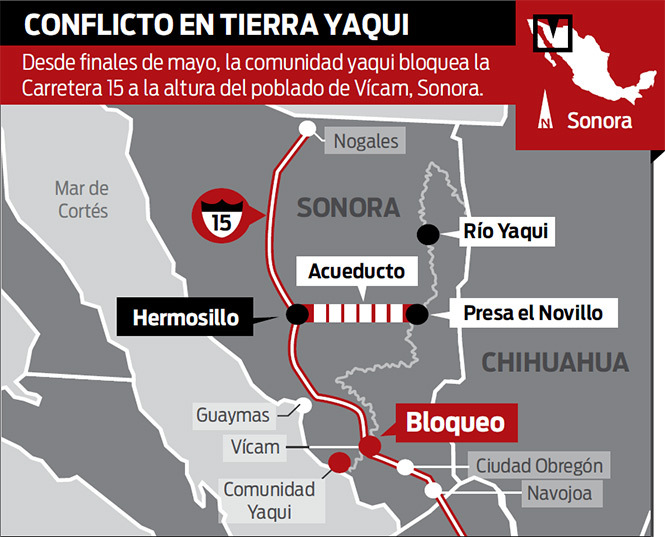

Intermittent blockades of Route 15 have been one tactic used by Yaqui resisters in response to the theft of their water in the last few years. The rapid growth of the City of Hermosillo in the state of Sonora, Mexico situated along the CANAMEX Corridor, on the way to the Port of Guaymas, is due in part to NAFTA-fueled agribusiness and mining which are the primary water-users. As it is, Sonora essentially exports millions of gallons of fresh water to the US in the form of fruits and vegetables. In the context of the drought and overuse of water, and as a result of the ways international trade has impacted Sonora, Hermosillo has required acquisition of water, impacting the Yaquis, Mayos, and Guajiríos with aqueducts and dams on the rivers. These mega-projects, enacted by Sonora SI (started by the Sonoran Governor who has a close relationship with the mining industry), have the intention of addressing the water crisis (for Hermosillo), contributing to the competitiveness of the region and providing new infrastructural projects for companies to make money from.

Since technology is now allowing for relatively affordable removal of salt from the plentiful ocean water, one megaproject planned for Sonora is one or more desalination plants. It is possible that the Agreement of Cooperation between the states of Arizona and Sonora signed by the respective governors at the Arizona-Mexico Commission’s Plenary Session last summer to jointly evaluate the feasibility of desalination at the Sea of Cortez for a new water supply for Arizona and Sonora is related to the Sonora SI project, which includes a desal plant in San Carlos near Guaymas. The potential for desalinated water piped from California or Mexico is part of Arizona's official water strategy. This year, a bill is in the Arizona House of Representatives to fund and arrange a study for the potential for desalination for Arizona. The intention for Arizona to expand and become more competitive in trade, along with potential new copper mine(s) will mean new demand for water, and with the combination of scarcity and new infrastructure, the water could be privatized. Desalination plants threaten the environment in various ways including the direct impact on their location on the water, as well as through the use of energy in the process and transport of the water.

Despite the likely need for drastic measures even if Arizona doesn't grow, some in Arizona find that expansion is necessary and inevitable. A so-called “megapolitan” area including Phoenix and Tucson called the “Sun Corridor” is intended as an economically integrated trade hub along the CANAMEX Corridor. Those interested in this concept have been attempting to reform state trust land law in the interest of further growth and development. The Sun Corridor concept is supposedly justified by—at the same time as it is used to encourage—growth and accompanying infrastructure especially for freight traffic in the area despite that growth is not sustainable in the area. The infrastructure required includes new roads, rail, ports, and border security.

Along with the steps to build Interstate 11, just in the last few months, Arizona opened trade offices in Hermosillo and Mexico City, committed funding to increase freight rail infrastructure near the border and to expand ports of entry at the AZ/Mexico border. According to ADOT's press release, Arizona was involved in a US/Mexico joint investment “implementing U.S. technology, equipment and training to enhance the efficiency of the military inspection station north of Hermosillo," which involves $6.8 million almost certainly from the Mérida Initiative, with an additional $4 million from the Mexican Government.

The primary intention of the Mérida Initiative (also known as Plan Mexico, a reference to the failed Plan Columbia) is supposedly to fight the drug trade, but one major role, to create a “21st Century Border Structure,” deals with trade and migration as well. This is meant to “Facilitate legitimate commerce and movement of people while curtailing the illicit flow of drugs, people, arms, and cash. The Mérida Initiative will provide the foundation for better infrastructure and technology to strengthen and modernize border security at northern and southern land crossings, ports, and airports.” Sure, the US wants to prevent the illicit activity that correlates with increased movement of trucks across the border. It is also the trade policies themselves, and the accompanying poverty and displacement, that contribute to migration (and arguably contribute to the drug trade). Many in US benefit from exploiting the cheap labor created by criminalization of migrants. And then there are the security and technology companies who can profit from infrastructure and equipment involved in securing the border. Large transnational companies such as Israeli company Elbit Systems brings their similar experience in militarizing the Gaza Strip and enforcing their apartheid wall to the border as well. The potential for any future Comprehensive Immigration Reform to bring about a "border surge" manifesting a massive profit-making opportunity for the military industrial complex to the US/Mexico border will likely make it even worse than it already is. Migrants continue to die crossing the border. Tohono O'odham who live along the border or visit relatives also face daily harassment, abuse, check-points, invasion of privacy, limits on movement, drones, cameras, etc. due to the border patrol's activities where the border bisects their lands.

Arizona officials and business leaders want to believe the myth that Mexico has the violence and organized crime under control. In the interest of becoming more friendly to international investment, for just a few years prior to the violent disappearance of the students from Ayotzinapa in late 2014, Mexico attempted to make itself look as though it was successfully instituting the rule of law. Yet law enforcement is clearly involved in much of this violence. And U.S. trade policy is largely culpable. Many violent acts tend to be depoliticized and obscured by associating the victims with drugs. Students at the Normal school in Ayotzinapa were known for protesting neoliberal reforms in Mexico. The fact that they were clearly not involved with the drug trade and that it involved so many youths made what happened to them more worthy of media attention.

The drug war, instead of curtailing the production and movement of drugs, functions, even if not specifically intended to, to facilitate resource-extraction and international investment in areas such as Mexico and Central America. Militarization and paramilitarization benefit US and transnational corporations' involvement there through displacement and social control, as described in Dawn Paley's new book, "Drug War Capitalism." With at least a couple dozen mining conflicts in Mexico alone, and the violence faced by activists who oppose mining, it is clear that even when organized crime groups are involved in law enforcement and violence, these are often acts of repression. For mining to continue, people are forcibly displaced, and the state facilitates this, in part by US tax dollars and to a certain extent for Arizona trade interests. Mining companies around the world often have arrangements with paramilitaries and/or military to protect them, such as in the cases of Resolution Copper's BHP Billiton in Columbia, and Phoenix-based Freeport McMoran in Indonesia.

In modern history in Arizona, displacement looks different but is no less significant. Confiscation of livestock, used as a tactic of attrition to force Diné who have resisted displacement from their lands so Peabody Coal can continue strip-mining the Black Mesa area, has occurred as recently as October 2014. Some members of Congress have recently urged that the relocation project be completed. Arizona's urban areas' access to water and electricity involves a mega-project that has a complex history few know about, which is all the more relevant in relation to the Yaqui water struggle and the potentiality of infrastructure being built for desalinated water. Often characterized as savvy and industrious, the efforts made to create the Central Arizona Project (CAP) that brings water from the Colorado River, and the whole project including Peabody Coal's strip-mining (to fuel the generating plant that powers CAP and provides electricity to Phoenix, Las Vegas and other areas), rests on a history involving manipulation, manufactured conflict between the Diné and Hopi and among tribal members, forced removal of families, contamination and depletion of water, and the poisoning of those who have lived close to the mines and the generating station.

Indigenous people's access to clean and plentiful water has been threatened since settlers arrived, even after they were given priority water rights by the federal government. Not only did Southern Arizona settlers divert water away from sources Tohono O'odham and other indigenous people relied upon, and contributed to erosion of their lands, indigenous people have been swindled for their priority water rights over the the last several decades. The Arizona Department of Water Resources considers the resolution of tribal water rights claims (9 more out of 22 total) the number one priority due to the uncertainty of long-term water availability for Arizona. Often the settlements promise infrastructure to provide water delivered to homes on the reservations, instead of addressing the root causes of poverty and lack of access to clean water. The mining industry consumes and contaminates water on a massive scale, and because of how much water it depends on, is especially interested in securing water rights at the expense of priority water rights held by some tribes in Arizona, such as in the case of Freeport McMoran being involved in the settlement of Hualapai water rights claims last year.

In some cases, mining companies like Freeport McMoran have been buying land for the associated water rights. Freeport and Resolution Copper have benefited from legislation and/or legal exemptions that allow them to essentially hoard water. No doubt the Resolution Copper mine near Superior would use several millions of gallons of water a year. Rio Tinto (of Resolution Copper) has purchased future water rights from CAP. The risk to water in AZ will be compounded if the Rosemont Copper mine near Tucson also gets approved. Access to clean water that is also affordable becomes a grave concern as water becomes scarce, commodified, and potentially privatized as more infrastructure is involved in its acquisition and treatment.

As is implied in "There is No Drought: California's Twisted Waterways," the threat of a serious drought can be used by those interested in profiting off the scarcity of water, and the "solutions" which are proposed are those that benefit these private interests. Obama made water privatization in the US easier, when on June 13 of 2014, he signed the Water Resources Reform and Development Act (WRRDA) into law. This included the Water Infrastructure Finance and Innovation Authority (WIFIA) which is a 5-year pilot program providing financing for P3s for water projects. WIFIA, mirroring the "Transportation Infrastructure Finance and Innovation Act" (TIFIA), was a concept developed and promoted by the American Water Works Association (AWWA). The new director of the Arizona Department of Water Resources was a member of the AWWA.

Additionally, various companies involved in other Arizona infrastructural projects (AECOM, CH2MHill, CDM Smith, Bechtel) are involved in water privatization across the world.AWWA, a non-profit, is supported by CH2MHILL and closely affiliated with AECOM. And with more P3s for transportation, the likelihood for P3s for water increases.

Private interests have pushed for Interstate 11 due to its role in trade. I-11 is also likely to be procured as a public-private partnership (or several). Public-private partnerships (P3), a type of arrangement which we'll be seeing more of in the coming years (and is in the works for the South Mountain Freeway), are proposed as a mutually-beneficial solution that uses complicated financial strategies to leverage state assets and essentially provide federal and/or state subsidies (through tax-free bonds, low-interest loans, etc.) to the private sector. It helps finance projects for which funding is otherwise lacking—therefore it is a much desired arrangement for construction and engineering companies, consultants, as well as banks. The P3 creates new profit opportunities for financial institutions, in the meantime creating more debt, and therefore it is largely about financialization. A P3 can also be understood as a form of privatization, not because a P3-built road would not be publicly accessible, but because P3s afford private entities influence, agency, and financial deals they would otherwise not have access to. Projects such as roads are more likely prioritized based on the interest of private parties, and based on what is incentivized by the federal government. A public-private partnership could also refer to an organization ("P3 unit") that involves public officials and private members, creating new forms of governance that provide opportunities for private involvement in decision-making.

Two such P3 units of note in Arizona are the Arizona-Mexico Commission (AMC) and the Transportation and Trade Corridor Alliance (TTCA). Both of these organizations involve the Director of the Arizona Department of Transportation and other state officials as well as various corporate leaders, with much overlap between the two. The pro-NAFTA AMC, who takes credit for pushing CANAMEX along, seems to have had a lot to do with getting TTCA instituted and becoming a major influence in Arizona policy on trade and transportation in recent years. Freeport McMoran has been a major sponsor of AMC and has had someone on the board of directors for several years. The locations of Freeport's Arizona mines and their use of the Port of Guaymas correlates with their interest in CANAMEX and I-11. Freeport hired the last director of the Arizona Department of Water Resources as their water strategist, and this department now has an intimate relationship with AMC, even listing AMC

It is no surprise as well that Senator John McCain has been a large proponent of the land swap for Resolution Copper, the Mérida Initiative, increased trade with Mexico, and the TPP. But this goes far beyond him and the AMC. Across the world, the World Bank and IMF have coerced countries into adopting structural adjustment programs or other changes in exchange for access to loans. We may be aware of austerity measures in the US, but we may not realize the various ways in which Arizona (or other US states for that matter) is also impacted by state-enabled free market ideology even as the state is not forced into formal agreements to open new areas up to private "partners." The economic development, made to seem intended to create jobs and improve the livelihoods of citizens is about nothing more than accumulation of wealth. It is clear though, that whether we call it neoliberalism, capitalism, or colonialism, is also a project of the state.

Sunday, June 19, 2011

Stolen Labor on Stolen Land

The video below of Harsha Walia of No One is Illegal in Canada is a couple years old, but i just came across it and wanted to share it.  She addresses some of the common struggles between indigenous and immigrant communities and what solidarity looks like.  These things are being increasingly discussed in Arizona.  The primary issue is the marginalization of the impacts on indigenous people the border has, and in particular, how Comprehensive Immigration Reform will more than likely bring increased border militarization to indigenous communities along the border.

There is also a marginalization of local indigenous struggles in favor of a concept of pan-indigenism (if indigenous issues are brought up at all).  One local struggle is against the Loop 202 South Mountain Freeway extension.  There was a recent action addressing a member of the Maricopa County Board of Supervisors who has come into conflict with Arpaio over his immigration sweeps.  To me, this action not only calls out Wilcox, but those who see her as an ally in the immigrants rights struggle.  It has become more clear that she is not an ally (not even to migrants) especially because of her involvement in the pro-NAFTA Arizona-Mexico Commission which is a private entity influencing policy and development.

 The statement says, "Mary Rose Wilcox... you continue to posit yourself as some champion of immigrant and worker rights... [W]e are pro-migrant, and in our support of immigrants who have been dispossessed by predatory American trade policies, we recognize that it is those trade policies, in particular NAFTA, that are the enemy of all workers in North America. What, then, is solidarity when you support all of these conditions that line the pockets of corporations, while keeping indigenous people, workers, and immigrants down?
It is your involvement in the Arizona-Mexico Commission that signals your complicity with the exploitation caused by neo-liberal trade that continues to impact people’s lives in Mexico by dispossessing them and keeping wages in the toilet, forcing the poorest to migrate for survival... Another of the consequences of increased trade between Arizona and Mexico are the proposed freeways that would devastate the land and air, in particular the proposed Loop 202 freeway extension through the Gila River Indian Community (Akimel O’odham land). Surely, you’re aware that the tribe has opposed the freeway extension, as both District 6 in Gila River, and the tribe as a whole has previously opposed any new freeway, so it should be no surprise that there continues to be opposition..."  Read the entire statement here.


Thursday, June 9, 2011

Designed to Kill: Border Policy and How to Change it (Crimethinc)


This article is from the Crimethinc. reading library. I imagine it'll be printed in Rolling Thunder. It is definitely worth a read, really well written, and covers so much ground regarding the issues. If this piece of writing had existed 5 years ago, i probably wouldn't have felt so compelled to start my own writing on such subjects.

There are a few things I would've said differently, but one thing i especially wish it would've addressed more was the way the border impacts indigenous communities on the border. I think this is such an important piece of the puzzle, especially when so many anarchists and other anti-authoritarians support others' fight for Comprehensive Immigration Reform which would only contribute to more border militarization.

Designed to Kill: Border Policy and How to Change it

For a number of years now I’ve worked in the desert on the Mexican-American border with a group that provides humanitarian aid to migrants who are attempting to enter the United States—a journey that claims hundreds of lives every year. We’ve spent years mapping the trails that cross this desert. We walk the trails, find places to leave food and water along them, look for people in distress, and provide medical care when we run into someone who needs it. If the situation is bad enough, we can get an ambulance or helicopter to bring people to the hospital. We strive to act in accordance with the migrants’ wishes at all times, and we never call the Border Patrol on people who don’t want to turn themselves in.
During this time I’ve been a part of many extraordinary situations and I’ve heard about many more. Some of the things I’ve seen have been truly heartwarming, and some of them have been deeply sad and wrong. I’ve seen people who were too weak to stand, too sick to hold down water, hurt too badly to continue, too scared to sleep, too sad for words, hopelessly lost, desperately hungry, literally dying of thirst, never going to be able to see their children again, vomiting blood, penniless in torn shoes two thousand miles from home, suffering from heat stroke, kidney damage, terrible blisters, wounds, hypothermia, post-traumatic stress, and just about every other tribulation you could possibly think of. I’ve been to places where people were robbed and raped and murdered; my friends have found bodies. In addition to bearing witness to others’ suffering, I myself have fallen off of cliffs, torn my face open on barbed wire, run out of water, had guns pointed at me, been charged by bulls and circled by vultures, jumped over rattlesnakes, pulled pieces of cactus out of many different parts of my body with pliers, had to tear off my pants because they were full of fire ants, gotten gray hairs, and in general poured no small amount of my own sweat, blood, and tears into the thirsty desert. Read more...

Tuesday, January 18, 2011

National Guardsmen Caught in Drug Smuggling Bust

So they say the border isn't safe and that's why we need the national guard there, but then when national guardsmen are involved in a huge drug-smuggling ring, the former AZ attorney general says, "The involvement of uniformed military personnel and children show the extent to which the cartels will go to pursue their illegal schemes."  It doesn't show the extent that national guard statesmen can go because they're not looked at with suspicion?

The involvement in the drug trade by military, police, border patrol, prison guards, not to mention the CIA and such, has been extensive.  It is ridiculous that migrants are the ones stereotyped as drug smugglers (yes there are drug smugglers from south of the border just like there are white drug dealers in middle class neighborhoods) and when people with some sort of authority get involved in the drug trade it supposedly speaks more to "the extent to which cartels will go".  Similarly, I point out in Ex-ICE Officer Charged in Drug-Smuggling, there is much more sympathy towards officials than towards Mexicans.  As though Mexicans are naturally corrupt, while officers get corrupted by the former.

No it couldn't be American demand, plus greed, poverty, capitalism, and the fact that drug smuggling (and human smuggling) is illegal that causes people to get involved in the trade.  And it wouldn't be the impunity, authority, and trust afforded officials that allows them to participate in the drug trade more effectively because of their position that causes them to be involved.  One wonders what the drug trade would look like if nobody tied to the government ever participated in it.

It's especially unfortunate that the drug trade negatively affects the Tohono O'odham and then on top of that, they have people who are "protecting the border" also negatively affecting the community, in addition to some involvement in the drug trade.  People transverse the entry port in the Tohono O'odham Nation and surrounding areas because of tightened border controls in other more urban regions.  It will be interesting whether this will be an excuse to tighten border security on T.O... just before the Unity Run too...

Anyway, here's the article: Authorities bust major marijuana smuggling ring. 
And Ex-ICE Officer Charged in Drug-Smuggling is worth reading too, in my opinion, even though it's a little old.

Friday, January 14, 2011

Private Paramilitary-Style Training Camp Approved for Border

A company called Wind Zero got approval to build a huge private complex for paramilitary-style training, similar to the camp proposed by Blackwater (now Xe).

According to Narco News' $100 Million Drug-War Garrison Approved for U.S.-Mexican Border, the company's founder, former Navy SEAL sniper, U.S. intelligence agency operative and author Brandon Webb said in a YouTube video: 
Mexico is very close to civil war right now; it doesn’t take much to buy off somebody and next thing you know, the president is assassinated and then what? A civil war breaks out, and we have a million Mexican citizens crossing the border into the U.S., and it’s the same situation that you have in Afghanistan and Pakistan. You have all these refugees coming across and Pakistan’s like, “What do we do with this?”

It’s not outlandish for that scenario to happen. So how do you prepare for that? You got to train these guys, and that’s law enforcement and the military.
The article notes that there are likely to be plans to operate drones, aka unmanned aerial vehicles (UAV) out of this facility.
Currently, under the oversight of the Department of Homeland Security’s Customs and Border Protection agency, about a half a dozen Predator B (Reaper) drones are now operating along the southern U.S. border and coastal regions of the U.S., from Florida through Eastern California.
And it seems the Mexican government itself is operating UAVs, or drones, over the U.S.-Mexican border. A recent news story revealed that a Mexican drone dropped out of the sky earlier this month and crashed onto an El Paso, Texas, street...
The U.S. and Mexican governments are already operating joint military missions targeting so-called “kingpin” narco-traffickers. As evidence of that reality, the Washington Post recently reported on a State Department cable made public through WikiLeaks that supports facts reported by Narco News in June 2010...

Would it be any surprise if the U.S. and Mexican governments, via private contractors and/or government operations, also are coordinating drone missions along the border?
(It's worth noting as well that Miami Police have recently purchased a drone for the use of keeping tabs on the residents as well.)

About the training "camp" Narco News continues: 

Beyond its usefulness as a drone operations and training center, the planned Wind zero camp also will offer plenty of other features necessary for training special operations soldiers and/or paramilitary forces.
The camp, which would be developed in three phases at a cost of up to $100 million (some $15 million for Phase 1), also will include numerous shooting ranges allowing for some 57,000 rounds of ammunition to be fired off daily; a mock-up of an urban neighborhood for practices assaults; a 6-mile dual-use race track for teaching defensive and offensive driving (and for private-pay recreational use); and enough housing and RV camper space (along with a 100-room hotel) to accommodate a small battalion of warriors.
The article states that residents of the town, in addition to the Sierra Club have opposed this project, but, "Wind Zero marshaled the support of numerous law enforcement agencies in the region that would be able to make use of the facility for training purposes."

Monday, July 5, 2010

SB1070: Will Be Stopped, but Worse Will Come from Feds

Here's my prediction about SB1070. It may or may not go into effect on July 29th, but I think it will be stopped in some way, probably by the federal government. Then the federal government will come up with some Comprehensive Immigration Reform that is as bad or worse than SB1070, but not as blatantly horrible. It will provide a few crumbs for certain folks- perhaps to buy off the some of ones with the most capacity to build resistance, but it will involve more border security and attrition through enforcement (with a new gentler formula). We are also possibly going to see a guest worker program and perhaps some sort of id that involves biometrics.

After Prop 187 in California passed it was found to be unconstitutional. Yet it was important historically because it set things in motion. In particular, the federal government passed welfare reform that instituted restrictions on welfare to immigrants that mirrored some of prop 187.

The excerpts at the end of this post, from Border lines blog discuss the reasons the federal approach to immigration is not likely to be much different from AZ's.

This is why I say This is bigger than SB1070. We have people coming to Arizona from out of town, doing this Arizona Freedom Summer (beware the RCP) and thirty actions in thirty days sorts of things, but need to be clear that SB 1070 is not the main issue here. People keep voting for Sheriff Joe and racist legislation- there need to be some efforts to change minds and/or undermine the strength of racism here. As I've mentioned before, if we don't look beyond the pieces of legislation and the bad sheriffs and the raids, the economic situation that so many face is overlooked. We also have a criminal "justice" system that seeks to criminalize people they see as a problem- particularly people of color, whether immigrants or not. In seeking to move immigration reform along, some folks think it's okay to further militarize the border even when it already harms the communities such as the O'odham down at the border.

For more reading on these topics (especially if you're new to these issues in AZ), see This is Bigger than SB 1070. Whether or not my prediction comes true, this is still bigger than the latest law. It was too big before.


From Border Lines blog:
It’s likely that SB 1070 will be judged, in whole or in part, as unconstitutional and will never be fully implemented. Even so the Arizona law marks another step forward in the consolidation of the attrition through enforcement strategy, just as its Legal Workers Act of 2008, which the courts have upheld, signaled the deepening dimensions of immigration law enforcement...

The Arizona law highlights a deepening conundrum for the federal government. By no means is DHS opposed on principle to having local law enforcement join in immigration enforcement. But it does insist that such cooperation be on the terms it sets. Having opened the door to federal-local cooperation, DHS is finding it hard to control the eagerness of localities to join in the immigrant crackdown...

With its Support Local Law Enforcement Act, Arizona not only adopted the “attrition through enforcement’ framework of the restrictionist institutes. It also adapted parts of the federal playbook for immigration enforcement: identifying new ways to increase what DHS calls “law enforcement partnerships” and extending the federal government’s own focus on the expanding category of “criminal aliens.”

Rather than waiting for DHS to reach out and expand its own federal-local collaborative programs, Arizona politicians have asserted the state’s right to enforce existing federal immigration laws. In the view of the supporters of the new law, the main problem they are attempting to address is not some inadequacy in federal immigration law. Rather it’s the failure of the federal agencies to adequately enforce the law...

The federal government has not explicitly endorsed ["attrition through enforcement"], but its actions are closely attuned with this restrictionist agenda.

Even as the White House and DHS continued to insist that only a CIR strategy will fix the broken immigration system, it has systematically moved to make it increasingly difficult for unauthorized immigrants (illegal border crossers and those overstaying their visas) and for legal immigrants who have violated criminal laws (mostly drug use) to live and work in the country. At the same time, DHS has steadily strengthened border control through increased checkpoints, increased agents, and increased border-control infrastructure...

The Obama administration has also proved an ardent advocate of increased federal-local cooperation in immigration enforcement. Among other things, it has strongly supported collaborative programs initiated by the Bush administration such as Operation Community Shield, Criminal Alien Program, Fugitive Operation Teams, Operation Stonegarden, Border Enforcement Security Taskforces (BEST), and the 287(g) program – all of which involve local police and sheriff deputies in the enforcement of immigration law.

In addition, the Obama administration has consolidated and promoted the Secure Communities program, which was developed under DHS Secretary Chertoff as a pilot project to encourage and facilitate the checking of the immigration status of all those arrested by local law enforcement. Secure Communities is advancing rapidly under Secretary Napolitano, who has prioritized the detention and removal of all those DHS and the Justice Department identity as “criminal aliens.”

Immigration and Customs Enforcement (ICE), the DHS agency responsible for immigration investigations and interior enforcement, has a special program to promote what its calls “law enforcement partnerships.” ICE Access (Agreements of Cooperation in Communities to Enhance Safety and Security) “provides local law enforcement agencies an opportunity to team up with ICE to combat specific challenges in their communities.”

Established in 2007, ICE Access underscores the increasing outreach of DHS to local law enforcement officials in immigration and other homeland security matters. The program supports “a multi-agency/multi/authority approach that encompasses federal, state, and local resources, skills, and expertise.”

Monday, May 3, 2010

Freedom Not Reform: Native Struggle from Margin to Center

If I told you that the National Guard and Border Patrol were sent to the Phoenix area to enforce immigration law, that the NG or BP drew their guns on people at check points because they had brown skin, that the NG or BP would show up in the middle of the night in masks to interrogate families about drugs, what do you think would happen? (Okay, well the police might be doing this to some extent already, but what if this was happening on a mass scale in response to illegal immigration?) More copwatch patrols, forums, meetings, protests, boycotts? Or would we step it up?

This has already been happening along the border to the Tohono O'odham on the reservation.
As for the border patrol abuse, O’odham have no rights. An elderly couple while under interrogation was forced to show a shopping/groceries list to prove that their travel on the road was justified. The border patrol can drive their vehicle into your yard and hold you at gunpoint and can confiscate your tribal identification card and make a request for further proof of “American citizenship" (Source).
You didn't know? Well, this is not a time to just feel guilty, but to reconsider your myopic support for Comprehensive Immigration Reform (if you indeed support it without hesitation). Have you seen any proposals for Reform that don't include more border security? Border security means (more) militarization.

Not only are the politicians (Democrats and Republicans alike) proposing more border security, but this is also coming from seemingly grassroots sources. For example, the 1 Million People for Comprehensive Immigration Reform in 2010! Facebook page, of which over a tenth of my blog's facebook account's friends are fans of lists "Border Security" as one of their positions. Even if we only look at the situation of undocumented immigrants, we must realize that there will still be people considered illegal and will be just as many if not more people dying crossing the border!

I can hear the argument now: We need to include securing the border because that's the only way we can get so many undocumented immigrants legalized. I wouldn't be surprised if a number of CIR supporters even felt that the border needs to be secured for economic reasons or due to terrorism.

I also imagine a handful of CIR supporters want the federal government to find a solution to the economic problems in Mexico. Whether or not this is realistic is somewhat beside the point. The reason indigenous struggles and experiences are marginalized is partly because otherwise we would have to question the legitimacy of this nation in the first place. We would have to question our presence (those of us who are immigrants from Europe especially) here, and our sense of entitlement to the resources that the land provides, if we were to consider those who have been impacted by colonization. We have been made to believe that native people are mostly gone or content on their reservations, that they have mostly chosen to assimilate, choosing to believe what we've been taught rather than seeking out the truth about things like Indian Schools and the horrors that accompanied them.

On the situation of native people on the border, O'odham Solidarity Across Borders says it best:
The passing of SB1070 leads us to the police state, and does not just affect migrants, it affects us all! SB 1070 like policies already occur on the Tohono O'odham Nation since the mid-90's with the states push for immigration enforcement. Border Enforcement that would be a Berlin-like Wall through our lands to control movement. The current push for immigration reform by politicians and by reformist activists includes the push to secure “their” borders which would be the forced removal and relocations of all indigenous tribes that live in the border region (Yaqui, Lipan Apache, Mohawk to name a few). This dismissal not just shows the colonial attitude that both reformist activists and politicians have, but also the settler privilege that they evoke when constructing border policies.

We need to be asking the why in all this? Immigration Reform to us, means militarization of our homelands, so we dare to ask the politicians and reformist activists, how can reform for many, be at the expense of the original inhabitants of the land? We need to see it for what it is, and question neo-liberal projects, such as NAFTA, not just put a bandage on policies that affect everybody! We must challenge both the politicians and reformist activists that try to pit indigenous and migrant communities against each other in their “political” solutions! We are in this together, and must start at the root of the problem, in this case from an O'odham perspective. (Read the rest!)

This is only one of the reasons I have seen for not supporting reform. I can't stress the importance of this. Even people who hear about it seem to sweep the issue aside. Especially if you live in Arizona, this needs to be brought out of the margins of your world. Even if you don't live in AZ, this is clearly happening in different ways to different people whether on the border or not. Forced relocations and control of movement as well as militarization have been used against indigenous people all over.

Clearly by bringing O'odham and other native struggles with border militarization out from the margins, we put the border itself to question- not just the wall, not just the border patrol. And by questioning the border's legitimacy, we also question the legitimacy of this nation- not just the wars it wages, not just the over-consumption, but even the founding fathers and the constitution.

What I have been arguing in reference to CIR is that if we do not demand freedom, it can't happen. If we downgrade the fight to reform, we are selling so many people short and continuing to leave people in the margins.


See also: Reading up on O'odham border struggle,
Biometrics Still Likely to be Part of Reform
,
Freedom, Not Reform: On the New CIR-ASAP bill
, Freedom Not Reform: If we don't demand it, it can't happen

Thursday, February 18, 2010

Reading up on O'odham border struggle

Far too often in my writing and my actions, I have marginalized O'odham experiences and struggles regarding the border and the effects of immigration enforcement on the reservation and in the city. I am not the only one, so in reading up on the issues, I am sharing the links below with you so you can also read up. These issues should really be central for so many reasons.

For one, the injustices that O'odham face are sometimes worse because they are invisible to so many. It is also part of an ongoing onslaught of colonialism (on the part of the Spanish then the Mexican State then the US) and white supremacy. We can see many patterns when looking at the historical and present forced removal of indigenous people from their lands in the US, and the way migrants (mostly indigenous) are also forced from their land by economic and other conditions. If we are concerned solely with racial profiling and legalization for the undocumented, we are perpetuating harm by allowing it to continue. Calls for comprehensive immigration reform do not tend to call into question the demand for border security. The government might legalize a bunch of people (maybe) but will there be more border walls? Won't there still be the conditions that have led to mass migration in the first place? I have more to say on this, but I will work on that later.

A quick note though, I included several documents on the border issues, but I also wanted to include some info on the south mountain freeway which you should especially know about if you live in Maricopa County. This isn't so much related to the border, but if it gets built on the reservation, it will displace people and put a border/barrier through their communities. If there is destruction to south mountain, it would disturb a sacred site. There are many to ignore the local struggles of people here, but you should know about it.


Websites:
O'odham Solidarity Across Borders Collective

O'odham Solidarity Project

Articles/Documents:
Fear of a Milighan Planet part 1 and part 2

Immigration, Imperialism and Cultural Genocide: An interview with O’odham Activist Ofelia Rivas concerning the effects of a proposed wall on the US / Mexico border Interviewed by, Jeff Hendricks

RESISTANCE AND COLLABORATION O’ODHAM RESPONSES TO U.S. INVASION by J.D. HENDRICKS

Traditional O'odham statement at the Zapatistas' Encuentro 2007

Shame on the New York Times for Fueling Border Misery By Brenda Norrell January 2010

Hate and Death on the Border By BRENDA NORRELL December 2009

O'odham: Surviving apartheid on the illegal border By Brenda Norrell November 2009

A Border Runs Through Them: The Struggles of the Tohono O'odham By BRENDA NORRELL November 2009

Indigenous Peoples Vow to Bring Down Apartheid Border Wall by Brenda Norrell November 2007

Indigenous Border Summit Opposes Border Wall and Militarization By Brenda Norrell October 2006

Video:
Tohono O'odham and U S Border Patrol (youtube video)

Imaginary Borders, Real Obstructions (youtube video)

Videos on the South mountain Freeway:
South Mountain Freeway Proposal - Public Comments pt 1 and pt 2

South Mountian Freeway Protest

Article on Freeway:
Sal DiCiccio’s Loop 202 Problem: Phoenix Councilman Would Benefit from Reviled Ahwatukee Freeway Extension

Saturday, January 2, 2010

The Civil Rights Movement's Lessons for Anti-Arpaio March

"Not since the days of Bull Connor has this country seen a public official abuse his authority in order to terrorize and intimidate communities based on the color of their skin," states a call for the big January 16th march in Phoenix against Arpaio. Sheriff Joe Arpaio is often compared to Bull Connor, the police official in Birmingham who fought civil rights activists with attack dogs, and strong water hoses back in the 1960's. He acted above the law, although some could argue that his actions were not contrary to the general orientation of the rule of law then or even today. He was more blatant about abusing protesters and disregarding federal law than most law enforcement officials, which is why Arpaio is compared to him.

During the civil rights movement, there were no marches against Bull Connor, but there were efforts to produce situations in which he would show the world what he was willing to do to fight integration. The horrible treatment of marchers drew the attention of the nation and encouraged John F. Kennedy to initiate the Civil Rights Act of 1964. To some, the Civil Rights Act was a victory, and the story somewhat ends there. This perspective makes it seem that Bull Connor was an important catalyst and therefore target (although he wasn't quite a target in the way Arpaio is today). Yet if this was the case, why do stories that focus on a wider black liberation movement rather than focus on aspects of what's called the civil rights movement that often center on the federal government's benevolence or Martin Luther King's heroism not really mention Bull Connor at all?

If one were to argue that strategically it makes sense to go after Arpaio because of the significance of Bull Connor's role in getting the Civil Rights Act passed, I would say, Arpaio is our big villain, but just as Bull Connor was but a piece of the entire picture, Arpaio should not be the central focus of the current movement. According to The numbers don’t match Arpaio’s hype, Arpaio, despite having spent much more money and time and having wider jurisdiction and more media attention, arrested less people than city police departments in the county. The many politicians and those who elected them, the police, and ICE- all those who are enemies to undocumented people- make it clear that Arpaio is but one figure, and that opposition to racist attitudes must address something bigger than a politician, in many ways a symbol, no matter how monstrous. Yet the focus on Arpaio remains, locally and nationally.

Shall we just have marches against Arpaio until we get a crappy Immigration Reform bill? And maybe even get rid of Arpaio? Will that solve all the problems of migrants and others caught up in the arrests, checkpoints, and militarization of the border? We can bet that these things, especially the militarization of the border, will still exist after reform. There will still be "illegal" people, and a permanent underclass.

A call to action for the March in Phoenix on January 16th says, "It is time, just like Martin Luther King and the Civil Rights Movement took the streets of Montgomery Alabama that at that time was the epicenter of hate; we must do the same in Phoenix." The movement for immigrants’ rights is often compared with the civil rights movement, but we must ask whether the civil rights movement was even effective.

First, the civil rights/black liberation movement involved a lot of amazing work and the organizing by many people who are rarely credited for their contributions. Often their ideas about what should come of the movement are not recognized today. What is recognized are the agreeable aspects which the white mainstream chose to co-opt. It is not that the movement did not succeed exactly, but we are made to think that racism no longer exists because of the it. Yet we have the largest prison populations in the world and the relative majority of those in prison are non-white, and many are in for non-violent offenses. This is only one example of the way that racism has been disguised, yet still exists today.

Despite the fact that many people have been empowered by the amazing work by organizers of the civil rights and power movements, what happened is that while elements of the movement(s) were co-opted, others were effectively destroyed through the Counter Intelligence Program (COINTELPRO). Briefly, COINTELPRO sought to eradicate dissidence, to destroy Martin Luther King Jr., the Black Panthers, and other radicals, and was, with the help of local police and the criminalization of people, the downfall of many liberation movements.

It is difficult to use the civil rights movement as a model for a movement of today for these reasons (and many others), primarily because what most people know of it is what they are encouraged to know, their education about history filtered for the purposes of maintaining the status quo.

If we were to see the Civil Rights Act as a success of the civil rights movement, it would make sense for us to seek something comparable from the immigrants' rights movement. Another call to action for the January 16th march says, "Join us and march against the injustices and separation of families caused by the 287(g) and Joe Arpaio. We will be demanding that the Obama administration take direct action on the issues affecting our communities." Some calls for the march, seemingly mostly or solely coming from the National Day Laborer Network, call for comprehensive immigration reform.

Something many people don't know about are two riders added to the Civil Rights Act of 1968, one which outlawed crossing state lines (which includes using a telephone or sending mail across state lines) with intent to "incite a riot" and the other making it a federal crime to "obstruct law enforcement officers or firemen doing their lawful duty in connection with a civil disorder which obstructs a federally-protected function". Both of these have been used against Black Panthers, the American Indian movement, and various other radicals. This is yet another example of the way the federal government criminalizes dissent, as well as an example of how laws that claim to solve problems (such as discrimination) actually perpetuate those problems by undermining the people's ability to rebel, and by contributing to the filling of the prisons. Oh, and get this: the Civil Rights Act of 1968 that was meant to prohibit violence against black people exempted from prosecution any law enforcement officers, member of the National Guard and Armed Forces who are engaging in suppressing a riot or civil disturbance.

The integrity of the Civil Rights Bills aside, it is important to make the point that the federal government was involved in crimes against the people (such as through COINTELPRO), and watched as racists such as the KKK and southern police committed crimes against black people. One example is that the federal government was providing information about the Freedom Riders to the Birmingham police, who in turn was providing that information to the KKK. The Klan used that information to attack civil rights activists, such as when the freedom riders arrived at a bus terminal and the KKK beat them while the police waited to show up until most of the Klan members had left. The police were actually providing a lot of information about local civil rights activities, but who they were providing it to was especially interesting. The information was being given to a KKK member who was actually an FBI agent who had infiltrated the Klan. So the FBI knew all along that the information was being provided to the KKK, and they also knew the details of the various acts of violence the Klan and the police were perpetrating against the black population and civil rights activists. Keep in mind that Birmingham was being called "Bombingham" because of all the bombings at the time. Yet neither the FBI, nor the federal government in general, did anything to stop the horrible violence that was occurring even though they did have the ability to do so (Source). This is the government that benevolently gave us the Civil Rights bills?

So it must be asked, were the Civil Rights laws a success? I would concede that laws do shape people's attitudes, that outlawing racial discrimination shaped the white consciousness. Yet, on the flip side of this, laws and law enforcement have played a stronger role in justifying racist attitudes. I would argue that the criminalization of people, which did not start with the civil rights movement, but at that time was intentionally shifted towards appearing unbiased, is the newer face of racism. Certainly things have changed due to the civil rights movement, but we must ask what was it that really changed and what has not changed? As mentioned above, dissent has been criminalized, as well as has been poverty, drug use, etc. The police enforce the color line by partaking in harassment, brutality, and arrests of people of color. Especially relevant to this discussion is that movement across borders has been limited and criminalized, constructing a whole mass of people as criminals. From this perspective, the rule of law is perfectly congruent with racism. So Connor and Arpaio are not aberrations except in the way that they flaunt their penchant for abusing people. While not as blatantly racist as Connor was, Arpaio can still terrorize migrants under the power of the law.

Another question to be asked: Were the Civil Rights Bills written because of a moral imperative of the federal government, perhaps with a push from leaders like Martin Luther King Jr.? Or were they an attempt to quash dissent? After all, protests and riots were a major concern. What better way to deal with it than to throw the people a bone while you further criminalize rioting?

Malcolm X said, "You’ll get freedom by letting your enemy know that you’ll do anything to get your freedom; then you’ll get it... when you stay radical long enough and get enough people to be like you, you’ll get your freedom." Additionally, a couple months after the big March on Washington, Malcolm X described in a speech how the March was co-opted by the federal government; that originally the marchers were talking about how they were going to march on the government buildings and bring them to a halt, and even that they would lay down on the runways of the airports and stop planes from landing. This frightened the government so much, that got Martin Luther King Jr and others together to undermine the organizing for these activities by making it a passive march instead. "They controlled it so tight, they told those Negroes what time to hit town, how to come, where to stop, what signs to carry, what song to sing, what speech they could make, and what speech they couldn't make; and then told them to get out town by sundown." Yes, the government has its ways to undermine true dissent, and obviously it's not always through force. Reform is used to undermine revolution.

This is why I believe that if anything with a positive façade is to come out of Comprehensive Immigration Reform, it is out of fear of the power of the people. After all, no moral imperative is preventing the federal government from running all the detention centers, from militarizing the border, from being involved in the corrupt drug war, etc. (On the flip side, I believe the federal government is also afraid of the racists who scapegoat migrants and other people of color for their problems but also are angry with the government for collaborating with businesses to make money off of cheap labor). Even if you believe that new opportunities come with Obama in power, the fact remains: the rule of law is intimately tied to racism. History may not repeat itself, but there are many lessons to be learned.

It is also worth mentioning that Malcolm X's story should be considered when movement leaders invite cops to meetings, when activists police the behavior of the people during protests, and when they try to control the message.

To conclude, Arpaio mustn't be the focus for the movement, and neither should reform. Knowing that Arpaio, like Bull Connor, was elected time and again by a mass of white folks who feel that people of color are somehow a threat, and that the rule of law, with the participation of the federal government, is inextricably racist, we have much to do. We need to challenge white people on their racism and no longer legitimize the federal government or other law enforcement by comparing Arpaio the "Sadistic Man" to those whose acts of repression are simply less visible. We need resistance, no compromise on freedom. Lives are at stake. Freedom not reform.

This is all not to say you shouldn't attend actions like the march against Arpaio. In fact you should, and you should bring your message and your passion for freedom.

Further reading:
No Borders or Prison Walls: Beyond Immigrants' Rights to Ending Criminalization of All People of Color
and
Freedom, Not Reform: On the New CIR-ASAP bill

Thursday, December 17, 2009

Freedom, Not Reform: On the New CIR-ASAP bill

Please don't be fooled. If anything, the Comprehensive Immigration Reform for America's Security and Prosperity Act of 2009 is lip service at best. If you review the bill (the complete bill, not the summary), you will see a glaring lack at anything like a solution to the "crisis" so many speak of. Worse, it maintains that border security (read militarization) is important, includes employment verification, and also leaves out any mention of same-sex couples. It is unlikely to pass as is, or probably not even close, but I am concerned with so many people blindly celebrating this bill.

How about this as a summary for much of CIR-ASAP: review this, analyze that, assess this, study that, examine this, make recommendations, develop and implement a plan. This is the extent to which major questions are addressed: border deaths, costs of border security, human smuggling, Operation Streamline, etc. Certainly this gets nowhere near actually coming up with solutions to, much less acknowledgments regarding the injustices caused by the border and border enforcement. To me, it's nothing but superficial- surprising that they'd be mentioned, but still, just empty words. It doesn't take a genius to know that increased border security means increased deaths. Yet they are developing a study that would include "an analysis of whether physical barriers, technology, and enforcement programs have contributed to the rate of migrant deaths". And who would end up doing these studies? Is there any hope that they would be done objectively? And what then?

Not surprising at all is the callousness, or neglect of the impact on the indigenous communities and others as a result of continued border security. Let us not confuse a lack of a wall with lack of problems due to border security. The bill states, "Subject to the availability of appropriations, the Secretary shall establish a demonstration program to procure additional unmanned aerial vehicles, cameras, poles, sensors, satellites, radar coverage, and other technologies necessary to enhance operational control of the international borders of the United States." If anything, the bill seems concerned with making border security more efficient, maybe a bit more regulated and supervised.

Border enforcement has divided O'odham folks who live on both sides of and along the border, limiting their ability to participate in traditional ceremonies. Border patrol officers harass indigenous people, check points have been set up on the reservation at which further harassment and abuse occurs on a regular basis. The funnel effect caused by increased security in more urban areas like in El Paso and San Diego, has led to increased deaths on O'odham land (and surrounding border areas), as well as more drug smuggling, which negatively impacts the communities there. These issues have been worse than deprioritized by most people in the immigrants' rights movement. Far too often the colonial nature of the border is not considered, much less the everyday concerns of O'odham like the Loop 202 freeway.

There are some positive acknowledgments and solution-like proposals for how to handle detention. But it all really boils down to bigger cages, longer chains. No one belongs in a detention facility of any sort just for crossing the border illegally! Of course the government is not going to say such a thing. This is why I expect very little of any reform.

There is a large emphasis on consequences for employers who hire undocumented immigrants, but many of us have known for a long time that these measures have the most impact on migrants- the laws are meant to keep migrants from attaining work. It's funny that within the bill, there is a statement about preempting any state or local jurisdiction from "imposing any sanction" on people based on their immigration status. But isn't going after employers indirectly imposing a sanction on people based on their immigration status? A prime example is that in Arizona, an employer sanctions law was passed in January 2008, but has mostly or only negatively impacted workers- not employers. It has, in fact, been the justification for raids by the Maricopa County Sheriff's Office.

Some good news is that the authors of the bill oppose the Real ID. The bad news is they support electronic employment verification, which has and will continue to have many flaws.

Some are suggesting that this bill might pass with an addition of a guest worker program. I cringe when I think about the possible support for this, despite the implications of such a program. A guest worker program would only benefit businesses, and would not benefit workers, as has been seen in the past with the Bracero program, and existing programs.

In addition, the bill lacks any acknowledgment of the need for addressing same-sex couples' ability to stay together when one is legal and one is not.

The main failure of this reform is that it does nothing to put to question the idea that the border is legitimate in the first place. But why would it? As I've written before in Freedom, not Reform: If we don’t demand it, it can’t happen,
Illegal immigration is not wrong. What is wrong is the criminalization of people because of their class and countries of origin, and of the actions they have taken as a result of the decimation of economies and human rights by US business interests. What is wrong is that American businesses in and outside of the US have benefited from the cheap labor of Mexicans in particular, and others as well... Clearly no reform can be acceptable [to us] that the US Government, the perpetrator of violence against the people, will allow.
Again, I say, we need to demand Freedom, not reform, because otherwise it's not possible. Down with the Detention Centers! No More Border Security! No More Border! No More NAFTA! and on and on.


Thanks to Alex and Kevin for the information about impacts on O'odham.


Update: Read more about Sexual Assault in Detention Centers and CIR-ASAP

Friday, November 27, 2009

No More Deaths Volunteer Rejects Sentence, Charges US with Human Rights Violations

Walt Staton, the No More Deaths volunteer who was recently sentenced for "littering" near the border, has been given a new sentencing hearing after sending a letter to the judge opposing the punishment. His letter stated, "The simple truth is that US border enforcement strategy intentionally leads to the suffering and death of migrants - a clear violation of human rights...."

This past August, Walt received a sentence "consisting of a year of unsupervised probation and community service. He was ordered to complete 300 hours of trash pickup on public lands within a year. He was also banned from the Buenos Aires National Wildlife Refuge during that time (Source)."

This case has received much media attention, and hopefully will continue to do so, with this message of the reality of the security practices having created a tunnel effect by securing areas like San Diego/Tijuana, El Paso/Juarez so that migrants have little choice but to travel across areas of the border that are much more dangerous. In addition, even in these areas with no walls (yet), migrants have to choose trails that keep them more hidden from Border Patrol, and sometimes have to switch routes, which increases the chances of getting lost or worse.

In the time since Walt was charged, and just after thirteen more people got tickets, I was also able to see the area that a lot of the migrants have to travel through, while volunteering myself for No More Deaths. Although we were not on the Buenas Aires Wildlife Refuge, which is where NMD volunteers have been ticketed, I was not too far from there. Some of these areas are so mountainous that they can easily get lost or get hurt, taking days to get just a few miles north- if they make it at all. Although I had assumed that we would be in flat terrain with cactus and the chaparral, we were in rocky areas where trails are hard to follow (imagine a trail leading to the top of a bunch of rocks and you can't see the trail forward and you can't go north- where do you go next?). The heat of the summer made it many times worse. We were told by one group of migrants that their guide had told them it would only be a few hours to get to Phoenix from the southern side of the border. We saw them a couple days into their journey, one a seven year old boy, three of them sick, alternately in the summer desert heat and the drenching rain.

Here's an excerpt from an interview with Walt Staton in Splinter Generation about the reasoning behind the tickets.
SG: The fact that they confiscated the water is so upsetting.

WS: It’s such a fundamental thing. When anyone with common sense looks at it says, O.K. whether you agree with immigration policy or not, you have to be a complete crazy wingnut to say I want people to die in the desert. I mean, and it’s a very small minority of people that actually have that stance. You have a federal agency that is now saying our land is going to be a cemetery; we will not allow humanitarians to put water out here; we don’t want to sit down and meet with them; we want people to die. I don’t know, why else. It blows my mind.

SG: I read that patrolling this area is causing more damage than the water bottles ever could.

WS: Oh, border patrol has got all their four-wheel drive trucks, and Hummers, and Jeeps, and they’ve bulldozed all sorts of new roads so they can get into these areas where, supposedly, we’re protecting wildlife. They’ve got ATVs. They’ve got helicopters that are going day and night, that fly real low, and I can only imagine what that does to wildlife. They’ve built the wall right through the wildlife refuge, and nothing bigger than a lizard can get through it. They’re saying we’re trying to protect the wildlife and our refuge, and it’s like ok, show me, because right now you have got border patrol, and helicopters, and walls, and all this stuff all over it. That doesn’t look like a wildlife refuge to me. That looks like a war zone. And it is. It is a war zone.

And my earlier post on the subject: Here.

Wednesday, May 13, 2009

CAROB flier for Border Security Expo

This flier was passed out by CAROB and associates nearby the Border Security Expo that took place in Phoenix recently. It was handed to passersby- mostly baseball fans, others coming from the light rail station, a few people from the expo itself, and whoever else happened to be walking by...


The same mindset that has brought us freeway cameras is behind a Border Security Expo being held this Tuesday through Thursday at the Phoenix Convention Center. The event is sponsored by Raytheon, a company that manufactured a missile that killed 62 civilians in a Baghdad market in 2003*. Some of these technology companies are raking in millions, even billions of dollars to “secure the homeland”. But where does that leave us?


What does it mean that Homeland Security has nothing to do with making sure we all have homes?

Especially when so many people are losing their homes, security should mean shelter, food, health care, safety… Not more creepy biometrics devices. The government clearly is more concerned about fortifying the military and helping big business than it is about us.


Why are we allowing the government to manufacture enemies so it can award contracts to private companies? We know that private companies are making loads of money off of being part of one war or security effort or another. We know that lots of people profited from the lies that led to the US involvement in Iraq. The same companies (Boeing, Halliburton, Blackwater) are profiting or looking to profit from the continued militarization of the US-Mexico border.

The information communicated through the media about immigration is often created or distorted by white nationalists and others such as business owners who have an interest in the migrants being scape-goated. They would like us to blame the desperate and vulnerable migrants for our economic problems, rather than those who are profiting from those problems. They want workers to not get along, based on a silly concept like race, so they can continue taking advantage of us all, but especially immigrants.


What is the threat? Let us keep in mind that the first border patrol and physical barrier on the border are less than one hundred years old, yet some act like we’re doomed if we’re without a border wall. The billions upon billions of dollars to build a wall, buy border security technology, pay border patrol agents, detain hundreds of thousands of migrants, and deport them is hardly justified by the alleged costly impact migrants have on the economy. The impact of supposed over-population is nothing compared to the impact that big corporations- especially weapons manufactures- have on the planet.

And now the big deal is the drug cartels? The criminalization of drugs and people have created the unsafe conditions related to drug and human smuggling. Even though studies show that drug treatment is far more effective than enforcement, the government wants to perpetuate the violence at the border by increasing militarization.


How can we expect people to not migrate here if we are not willing to correct the damage we benefit from? Rich guys from the US who have investments in Mexico, such as car-parts factories, have an interest in and the power (with the participation of rich powerful Mexicans and cooperation of other US-based forces) to maintain the poor economic conditions in Mexico that ensure a cheap labor pool. US citizens benefit from the cheap products from Mexico, turning a blind eye to our participation in maintaining a situation in which people from Mexico need to seek better opportunities.


Do you think the increase in technology on the border will not affect you? What about the pastor from Tempe who got tased and beat up by DPS officers after refusing to open his trunk for the border patrol? How long till the border patrol check points are as maddening as going through security at the airport?


No to increased border security! No to the created divisions between us and our brothers and sisters based on immigration status! No to continued invasions on Indian land to supposedly secure the homeland! No to destroying the environment to build a wall!


*Corpwatch.org

Sunday, March 29, 2009

Breaking down the Mexican Drug War

It is interesting to see how quickly the debate about border security has become dominated by the issue of violence and drugs. I thought i was just hearing more about it because i became interested in the parallels between the drug war and the war on migrants, turning to narco news for information, which also resulted in me getting google news alerts on the merida initiative or plan mexico. I have several articles bookmarked, waiting for me to read so i can better understand the implications of the plan mexico and other responses to the violence and the drug trade.

The drug cartel violence has been in the news in the US more lately because Hillary Clinton went down to Mexico to talk about it, and Obama recently decided to send more agents down to the border. I believe that some people are mainly afraid of the violence touching US citizens. I believe there are other stronger political motivations for getting involved.

What i have made of it so far is that the violence has increased because the drug war in Columbia caused cartels to form or grow in mexico to transport the same cocaine, along with marijuana and other drugs. The political corruption in Mexico is well known. In fact, most people figure that in the war on drugs, it's just that one cartel has been favored over the others, leading to more access to resources and impunity and therefore more war over turf. Of course the mexican government would rather control the cartels, and several within the government probably want there to be no cartels. However, since illicit drugs are the number one source of revenue in Mexico, it's no wonder that so many people, from poor youths to police officers, to the president, and from what i hear even people in the US DEA, are involved in it.

An important part of this is Los Zetas, "former Mexican soldiers from an elite US-trained Special Forces team who deserted to work in the more lucrative drug trade". They were trained as death squads, and in torture at the School of Americas. "While Los Zetas started out as the Gulf cartel’s private army, they appear to be diversifying their operations. The DEA reported this year that it believes Los Zetas are attempting to break free from the Gulf cartel to form their own cartel... Los Zetas have entered the immigration industry in southern Mexico with relative ease and little resistance from other more established Mexican cartels." This and more information can be found at "Wall of Violence" on Mexico's Southern Border by Kristin Bricker. See also: US created monsters: Zetas and Kaibiles death squads by Brenda Norrell.

Despite knowing that Los Zetas were trained by the US and now are involved in the violence of the drug war that the US is so concerned about, the government wants to provide more resources and training to the mexican army. This also despite the common knowledge of the corruption. Of course, this isn't so unusual since we know that Osama bin Laden and others were also trained by the US.

The bad decisions made under the guise of a war against drugs also fits the pattern of the previous failed attempts in the war against drugs in Columbia. Efforts have not been made to deal with the demand for drugs (legalization, decriminalization and/or treatment). I believe that everyone mainly wants drug cartels under control. Whether or not they really want to stop the drug trade is another story. In fact, there is much evidence that the US government, or at least certain individuals are directly involved in the drug trade.

What I am primarily concerned about is what the training, resources, and whatever else is going to the mexican army will mean for indigenous and rebellious communities in mexico. There are already too many examples of disappearings, murder, torture, imprisonment, and other abuses as it is. Zapatista communities have been invaded by soldiers claiming to be looking for marijuana plants, despite the communities having a policy against drugs and alcohol. See another case: Video: Plan Mexico threatens peaceful Mexican communities. See also EZLN Criticizes the Drug War.

I think it was John Ross's book Zapatistas: Making Another World Possible: Chronicles of Resistance 2000-2006 in which he described foreign investor's concern that the Mexican government get the Zapatistas under control after the uprising in 1994. US investors have a lot of stake in being able to exploit mexican people and resources. Something that could not continue if they were able to break free. It is likely not a coincidence that the huge uprising in Oaxaca occurred recently and now the US government is getting involved militarily to help maintain the stability of the the country. On a side note, i find it interesting that so many anti-immigrant folks would argue that migrants should go back to mexico to fight for a better country. I hope that if it came down to it, those people would protest any effort the US government makes to help the mexican government stop a rebellion. I don't see that happening.

The Merida Initiative will also benefit the military industrial complex by putting money into buying US-made aircraft and other technology, as Kristin Bricker describes in US Releases $90 million in Plan Mexico Military Hardware and Training.

This drug war is, in a way, already affecting people in the US. Sheriff Arpaio is giving as his primary reason for pulling over every brown-skinned driver, the fact that some undocumented immigrants are falling victim to those involved in drug and human trafficking in maricopa county. This is resulting in the undocumented immigrants who get caught up in the sweeps lingering in jail, detention centers, or being deported, in addition to getting abused, in some cases, by officers (although aside from broken arms, i'd call the whole operation abuse).

In addition, youth of color in the US may be further targeted in the drug war. According to Kristin BrickerGangs: New Target in the War on Drugs? "Since the US is the world's biggest drug market and Mexican drug trafficking organizations' primary source of weapons, US officials can't blame Latin America for all of its drug woes. So they're turning to gangs. The US government recently released three major drug-related reports: the National Drug Threat Assessment, the International Narcotics Control Strategy Report, and the National Gang Threat Assessment. In all reports, gangs figure prominently in drug trafficking. The International Narcotics Control Strategy Report is broken down by country, and gangs feature prominently in almost every country report."

So the question is, what can be done? Although i never thought of myself as someone who would put effort into the legalization of drugs, this seems like a reasonable way to stop the drug cartels. In fact, i'm seeing more discussions about drug legalization in mainstream media and apparently El Paso's city council are talking about it as well. We know that the economic situation, as well as the natural corruptness of those in power are the main problem. People in the US need to bring to light was is really going on here, stop the Merida Initiative, and all militarization on the border, and in our communities. We need long term strategies fighting neo-liberal projects, capitalism, and the state in Mexico and the US.


Further reading:

US Police Train Mexican Police to Torture

Estado Fallido en México: Una justificación para la militarización (babel fish translation)

Why Plan Mexico will Crash and Burn

Video: Plan Mexico threatens peaceful Mexican communities